We use cookies to make your experience better. To comply with the new e-Privacy directive, we need to ask for your consent to set the cookies. Learn more.

Cell Signaling Camlg (D5l9j) Rabbit mAb
List Price
$342.39
Your Price
$342.39
Cell Signaling Camlg (D5l9j) Rabbit mAb - CSIG (Additional S&H or Hazmat Fees May Apply)
NETA PART:
CSIG-13913S
MFG.PART:
13913S
UNSPSC:
12352203
Manufacturer:
Cell Signaling


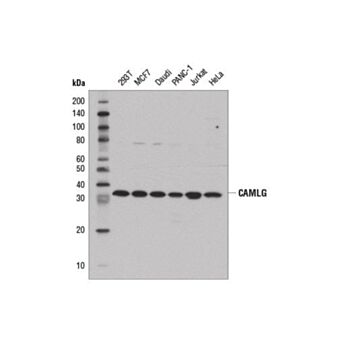
| Size | 100 µl |
| Reactivity | H M R Hm Mk |
| Sensitivity | Endogenous |
| Molecular Weight (kDa) | 32 |
| Source/Isotype | Rabbit IgG |
| Application/Dilution | {Western Blotting: 1:1000, Immunoprecipitation: 1:200} |
| Storage | Supplied in 10 mM sodium HEPES (pH 7.5), 150 mM NaCl, 100 µg/ml BSA, 50% glycerol and less than 0.02% sodium azide. Store at –20°C. Do not aliquot the antibody. |
| Specificity/Sensitivity | CAMLG (D5L9J) Rabbit mAb recognizes endogenous levels of total CAMLG protein. |
| Species Reactivity | Human, Mouse, Rat, Hamster, Monkey |
| Source/Purification | Monoclonal antibody is produced by immunizing animals with a synthetic peptide corresponding to residues surrounding Leu110 of human CAMLG protein. |
| Background | The calcium signal-modulating cyclophilin ligand (CAMLG) is a multi-pass endoplasmic reticulum (ER) membrane protein that plays an important role in calcium-mediated signal transduction. The CAMLG protein was first identified in T lymphocytes as a cyclophilin B-binding protein that regulates calcium influx following T-cell receptor (TCR) activation (1). Research studies indicate that CAMLG overexpression activates the transcription factors NFAT and NF-IL2A and leads to increased IL-2 gene transcription, providing additional evidence that CAMLG plays an important role in TCR signal transduction. CAMLG negatively regulates the non-receptor protein kinase Lck, which is critical for the thymocyte selection process (2). Thymocytes deficient for CAMLG fail to undergo normal development, accumulate reactive oxygen species, and exhibit increased apoptosis in response to cytotoxic stimuli (3). The CAMLG protein also acts as a receptor of TRC40, an ATPase that targets newly synthesized proteins in the secretory pathway to the ER membrane. CAMLG interacts with the protein insertion receptor WRB to form the TRC40 receptor complex that is responsible for insertion of tail-anchored proteins into the ER membrane (4). |
| SKU | CSIG-13913S |
|---|---|
| Featured | No |
| Supplier Part Number | 13913S |
| UM | EA |
| UNSPSC | 12352203 |
| Manufacturer | Cell Signaling |
| MSDS URL | Click here |
| Temperature | -20C |
| CountryOfOrigin | United States |
| ProductLine | CSIG |
| Qty | 1 |
| MinOrderQty | 1 |
| Weight | 7.000000 |
| Lead Time | 5 |
| Hazardous | N |
| ACT Ecolabel | No |