We use cookies to make your experience better. To comply with the new e-Privacy directive, we need to ask for your consent to set the cookies. Learn more.

Cell Signaling Girdin Antibody
List Price
$395.92
Your Price
$395.92
Cell Signaling Girdin Antibody - CSIG (Additional S&H or Hazmat Fees May Apply)
NETA PART:
CSIG-14200S
MFG.PART:
14200S
UNSPSC:
12352203
Manufacturer:
Cell Signaling


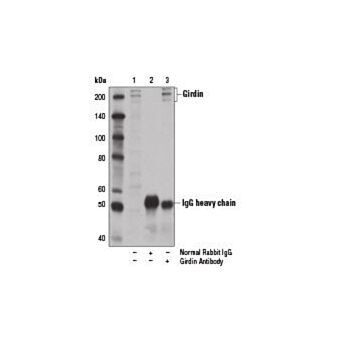
| Size | 100 µl |
| Reactivity | H |
| Sensitivity | Endogenous |
| Molecular Weight (kDa) | 220, 250 |
| Source/Isotype | Rabbit |
| Application/Dilution | {Western Blotting: 1:1000, Immunoprecipitation: 1:100} |
| Storage | Supplied in 10 mM sodium HEPES (pH 7.5), 150 mM NaCl, 100 µg/ml BSA and 50% glycerol. Store at –20°C. Do not aliquot the antibody. |
| Specificity/Sensitivity | Girdin Antibody recognizes endogenous levels of total girdin protein. |
| Species Reactivity | Human |
| Source/Purification | Polyclonal antibodies are produced by immunizing animals with a synthetic peptide corresponding to residues surrounding Glu1451 of human girdin protein. Antibodies are purified by protein A and peptide affinity chromatography. |
| Background | The actin-binding protein girdin (CCDC88A, GIV) is a non-receptor guanine nucleotide exchange factor (GEF) and part of a scaffold that mediates key signaling pathways during cell migration (1). Girdin protein structure includes an amino-terminal Hook domain for microtubule interaction, a coiled-coil dimerization domain, a Gα binding domain, a PI(4)P-binding domain, and a carboxy-terminal receptor-binding domain within a GEF motif (1-5). Akt kinase phosphorylates girdin at Ser1416, which promotes PI(4)P binding, localization of girdin to the membrane leading edge, and regulation of actin organization and cell motility (3). After growth factor receptor activation, girdin binds both G-protein and receptor to form an activation complex at the receptor cytoplasmic tail. The activation complex enhances receptor autophosphorylation and promotes downstream signaling that results in actin organization and cell migration (5). An activated growth factor phosphorylates girdin at its carboxy-terminal Tyr1764 and Tyr1798 residues to form an SH2 docking site for PI3K binding (6). The girdin GEF motif interacts with Gα and leads to release of Gβγ, resulting in further PI3K activation and the completion of signal transduction from receptor to cytoskeleton (7). The cytoskeletal reorganization and cell migration properties of girdin are important in regulating several biological processes, including wound healing, angiogenesis, and cancer progression (8-11). |
| SKU | CSIG-14200S |
|---|---|
| Featured | No |
| Supplier Part Number | 14200S |
| UM | EA |
| UNSPSC | 12352203 |
| Manufacturer | Cell Signaling |
| MSDS URL | Click here |
| Temperature | -20C |
| CountryOfOrigin | United States |
| ProductLine | CSIG |
| Qty | 1 |
| MinOrderQty | 1 |
| Weight | 7.000000 |
| Lead Time | 5 |
| Hazardous | N |
| ACT Ecolabel | No |