We use cookies to make your experience better. To comply with the new e-Privacy directive, we need to ask for your consent to set the cookies. Learn more.

Cell Signaling Beta-Amyloid (Pe3 Peptide) (D5n5h) Rabbit mAb
List Price
$154.53
Your Price
$154.53
Cell Signaling Beta-Amyloid (Pe3 Peptide) (D5n5h) Rabbit mAb - CSIG (Additional S&H or Hazmat Fees May Apply)
NETA PART:
CSIG-14975T
MFG.PART:
14975T
UNSPSC:
12352203
Manufacturer:
Cell Signaling


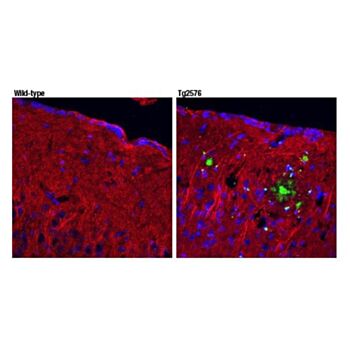
| Size | 20 µl |
| Reactivity | H |
| Sensitivity | Endogenous |
| Molecular Weight (kDa) | 4 |
| Source/Isotype | Rabbit IgG |
| Application/Dilution | {Western Blotting: 1:1000, Immunohistochemistry (Paraffin): 1:100, Immunofluorescence (Frozen): 1:200} |
| Storage | Supplied in 10 mM sodium HEPES (pH 7.5), 150 mM NaCl, 100 µg/ml BSA, 50% glycerol and less than 0.02% sodium azide. Store at –20°C. Do not aliquot the antibody. |
| Specificity/Sensitivity | β-Amyloid (pE3 Peptide) (D5N5H) Rabbit mAb recognizes recombinant pE3 form of β-amyloid peptides. This antibody does not cross-react with the non-pyroglutamate (E3) form of β-amyloid peptides. |
| Species Reactivity | Human |
| Source/Purification | Monoclonal antibodies are produced by immunizing animals with a synthetic peptide corresponding to residues near the amino terminus of β-amyloid (pE3) peptide. |
| Background | Amyloid β (Aβ) precursor protein (APP) is a 100-140 kDa transmembrane glycoprotein that exists as several isoforms (1). The amino acid sequence of APP contains the amyloid domain, which can be released by a two-step proteolytic cleavage (1). The extracellular deposition and accumulation of the released Aβ fragments form the main components of amyloid plaques in Alzheimers disease (1). APP can be phosphorylated at several sites, which may affect the proteolytic processing and secretion of this protein (2-5). Phosphorylation at Thr668 (a position corresponding to the APP695 isoform) by cyclin-dependent kinase is cell-cycle dependent and peaks during G2/M phase (4). APP phosphorylated at Thr668 exists in adult rat brain and correlates with cultured neuronal differentiation (5,6).Aβ peptides can be further modified by amino-terminal truncation that exposes a free glutamate residue to the enzyme glutaminyl cyclase, which catalyzes the formation of an amino-terminal pyroglutamate (pE) (7,8). Aβ (pE3) peptides exhibit increased stability relative to non-modified peptides due to an enhanced resistance to peptidase-mediated degradation (9) and a higher propensity to form β-sheets and aggregate (10). Antibodies targeting Aβ (pE3) peptides may be plaque-specific as there is no evidence for circulating Aβ (pE3) peptides (11). |
| SKU | CSIG-14975T |
|---|---|
| Featured | No |
| Supplier Part Number | 14975T |
| UM | EA |
| UNSPSC | 12352203 |
| Manufacturer | Cell Signaling |
| MSDS URL | Click here |
| Temperature | -20C |
| CountryOfOrigin | United States |
| ProductLine | CSIG |
| Qty | 1 |
| MinOrderQty | 1 |
| Weight | 7.000000 |
| Lead Time | 5 |
| Hazardous | N |
| ACT Ecolabel | No |