We use cookies to make your experience better. To comply with the new e-Privacy directive, we need to ask for your consent to set the cookies. Learn about our cookie policy.

Cell Signaling Traf4 (D1n3a) Rabbit mAb
List Price
$354.51
Your Price
$354.51
Cell Signaling Traf4 (D1n3a) Rabbit mAb - CSIG (Additional S&H or Hazmat Fees May Apply)
NETA PART:
CSIG-18527S
MFG.PART:
18527S
UNSPSC:
12352203
Manufacturer:
Cell Signaling


| Size | 100 µl |
| Reactivity | H M |
| Sensitivity | Endogenous |
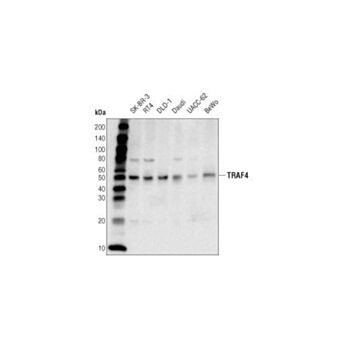
| Molecular Weight (kDa) | 50 |
| Source/Isotype | Rabbit IgG |
| Application/Dilution | {Western Blotting: 1:1000} |
| Storage | Supplied in 10 mm sodium HEPES (pH 7.5), 150 mm NaCl, 100 µg/mL BSA, 50% glycerol and less than 0.02% sodium azide. Store at –20°C. Do not aliquot the antibody. |
| Specificity/Sensitivity | TRAF4 (D1N3A) Rabbit mAb recognizes endogenous levels of total TRAF4 protein. An unknown background band is detected in some cell lines at 80kDa. |
| Species Reactivity | Human, Mouse |
| Source/Purification | Monoclonal antibody is produced by immunizing animals with a synthetic peptide corresponding to residues surrounding Arg124 of human TRAF4 protein. |
| Background | TRAFs (TNF receptor-associated factors) are a family of multifunctional adaptor proteins that bind to surface receptors and recruit additional proteins to form multiprotein signaling complexes capable of promoting cellular responses (1-3). Members of the TRAF family share a common carboxy-terminal "TRAF domain", which mediates interactions with associated proteins; many also contain amino-terminal Zinc/RING finger motifs. The first TRAFs identified, TRAF1 and TRAF2, were found by virtue of their interactions with the cytoplasmic domain of TNF-receptor 2 (TNFRII) (4). The six known TRAFs (TRAF1-6) act as adaptor proteins for a wide range of cell surface receptors and participate in the regulation of cell survival, proliferation, differentiation, and stress responses.TRAF4, also referred to as CART1 and MLN62, is a divergent member of the TRAF family with relatively weak binding to TNFR family members (5-7). Interactions have been observed between TRAF4 and the neurotrophin receptor p75-NGFR, lymphotoxin-β receptor, and GITR (8-10). While originally identified in metastatic breast carcinoma, TRAF4 has been shown to contribute to tumor growth and invasion in various cancers including breast, lung and colon (11-13). Expression of Traf4 is induced by the tumor suppressor p53 in response to DNA damage, and can promote apoptosis (14).TRAF4 has also been shown to play a critical role in TGF-β signaling, where it has been found to antagonize the E3 ligase Smurf, resulting in enhanced receptor stabilization driving breast cancer metastasis (15). |
| SKU | CSIG-18527S |
|---|---|
| Supplier Part Number | 18527S |
| UM | EA |
| UNSPSC | 12352203 |
| Manufacturer | Cell Signaling |
| MSDS URL | Click here |
| Temperature | -20C |
| CountryOfOrigin | United States |
| ProductLine | CSIG |
| Qty | 1 |
| MinOrderQty | 1 |
| Weight | 7.000000 |
| Lead Time | 5 |
| Hazardous | N |
| Energy Star | No |
| Green | No |
| Controlled | N |