We use cookies to make your experience better. To comply with the new e-Privacy directive, we need to ask for your consent to set the cookies. Learn about our cookie policy.

Cell Signaling Socs2 Antibody
List Price $161.60 Your Price $161.60
Cell Signaling Socs2 Antibody - CSIG (Additional S&H or Hazmat Fees May Apply)
NETA PART: CSIG-2779T
MFG.PART: 2779T
UNSPSC: 12352203
Manufacturer: Cell Signaling


| Size | 20 µl |
| Reactivity | H M R |
| Sensitivity | Endogenous |
| Molecular Weight (kDa) | 22 |
| Source/Isotype | Rabbit |
| Application/Dilution | {Western Blotting: 1:1000, Immunoprecipitation: 1:100} |
| Storage | Supplied in 10 mm sodium HEPES (pH 7.5), 150 mm NaCl, 100 µg/mL BSA and 50% glycerol. Store at –20°C. Do not aliquot the antibody. |
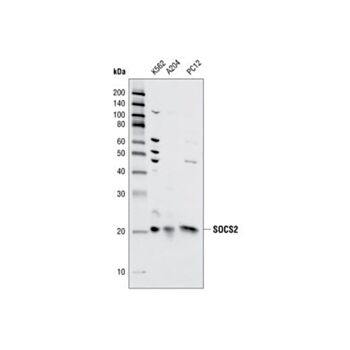
| Specificity/Sensitivity | SOCS2 Antibody detects endogenous levels of SOCS2 protein. |
| Species Reactivity | Human, Mouse, Rat |
| Source/Purification | Polyclonal antibodies are produced by immunizing animals with a synthetic peptide corresponding to residues at the carboxyl terminus of human SOCS2. Antibodies are purified by peptide affinity chromatography. |
| Background | The suppressor of cytokine signaling (SOCS) family members are negative regulators of cytokine signal transduction that inhibit the Jak/Stat pathway (1-3). The SOCS family consists of at least 8 members including the originally identified cytokine-inducible SH2-containing protein (CIS1), as well as SOCS1-7. Each SOCS family member contains a central SH2 domain and a conserved carboxy-terminal motif designated as the SOCS box. These proteins are important regulators of cytokine signaling, proliferation, differentiation, and immune responses.Activity of SOCS2 has been predominantly linked to growth hormone (GH) and insulin-like growth factor 1 (IGF-1) signaling but may also contribute to several biological processes including metabolism, bone formation, neuronal development, cancer, infection and other cytokine-dependent pathways (5). SOCS2 is widely expressed in adult and fetal tissues and is induced upon cytokine treatment (5,6). A number of studies suggest that SOCS2 can have either a positive or negative effect on GH/cytokine signaling (7-10). Mice deficient in SOCS2 grow signficantly larger than normal littermates (8). SOCS2 binds to tyrosine-phosphorylated GH and IGF-1 receptors via its SH2 domain, suppressing their signaling (6,9). In addition, the SOCS box of SOCS2 binds to Elongin B and C leading to activity as a ubiquitin ligase, promoting the degradation of the receptors as well as other SOCS family members (11-13). |
| SKU | CSIG-2779T |
|---|---|
| Supplier Part Number | 2779T |
| UM | EA |
| UNSPSC | 12352203 |
| Manufacturer | Cell Signaling |
| MSDS URL | Click here |
| Temperature | -20C |
| CountryOfOrigin | United States |
| ProductLine | CSIG |
| Qty | 1 |
| MinOrderQty | 1 |
| Weight | 7.000000 |
| Lead Time | 5 |
| Hazardous | N |
| Energy Star | No |
| Green | No |
| Controlled | N |