We use cookies to make your experience better. To comply with the new e-Privacy directive, we need to ask for your consent to set the cookies. Learn about our cookie policy.

Cell Signaling Rybp Antibody
List Price $320.17 Your Price $320.17
Cell Signaling Rybp Antibody - CSIG (Additional S&H or Hazmat Fees May Apply)
NETA PART: CSIG-33924S
MFG.PART: 33924S
UNSPSC: 12352203
Manufacturer: Cell Signaling


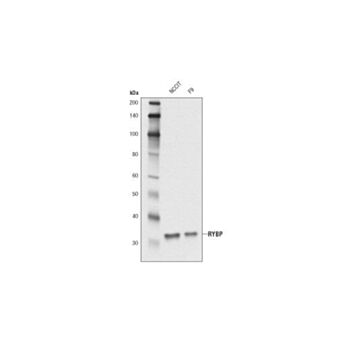
| Size | 100 µl |
| Reactivity | H M |
| Sensitivity | Endogenous |
| Molecular Weight (kDa) | 32 |
| Source/Isotype | Rabbit |
| Application/Dilution | {Western Blotting: 1:1000} |
| Storage | Supplied in 10 mm sodium HEPES (pH 7.5), 150 mm NaCl, 100 µg/mL BSA and 50% glycerol. Store at –20°C. Do not aliquot the antibody. |
| Specificity/Sensitivity | RYBP recognizes endogenous levels of total RYBP protein. |
| Species Reactivity | Human, Mouse |
| Source/Purification | Polyclonal antibodies are produced by immunizing animals with a synthetic peptide corresponding to residues surrounding Pro216 of human RYBP protein. Antibodies are purified by protein A and peptide affinity chromatography. |
| Background | Ring1 and YY1-binding protein (RYBP) is a widely expressed nuclear protein that functions as a modulator of Ring1A/Ring1B-dependent histone H2A monoubiquitylation (1-3). Ring1A and Ring1B proteins function as the catalytic core subunits of polyclomb repressor complex 1 (PRC1), which acts to repress gene expression in part through monoubiquitination of histone H2A on Lys119 (4). By binding to both the YY1 DNA-binding transcription factor and Ring1A/Ring1B, RYPB is able to recruit the PRC1 complex to target loci independent of prior tri-methylation of histone H3 Lys27 by the EZH2-dependent PRC2 complex (2,3). RYBP also binds monoubiquitinated H2A Lys119 and may act to stabilize or spread binding of PRC1 across large domains of repressed chromatin (5). In addition, RYBP directly stimulates the ubiquitination activity of Ring1A/Ring1B and is required for proper differentiation of stem cells along multiple cell lineages (2,3,6,7). RYBP has also been shown to bind MDM2 and block ubiquitination and degradation of p53, leading to cell cycle arrest and apoptosis in response to DNA damage (8). Many studies demonstrate that RYBP functions as a tumor suppressor protein. RYBP expression is decreased in multiple cancers, including non-small cell lung cancer, hepatocellular carcinoma, and glioblastoma with decreased expression correlating with metastasis and poor prognosis (8-11). |
| SKU | CSIG-33924S |
|---|---|
| Supplier Part Number | 33924S |
| UM | EA |
| UNSPSC | 12352203 |
| Manufacturer | Cell Signaling |
| MSDS URL | Click here |
| Temperature | -20C |
| CountryOfOrigin | United States |
| ProductLine | CSIG |
| Qty | 1 |
| MinOrderQty | 1 |
| Weight | 7.000000 |
| Lead Time | 5 |
| Hazardous | N |
| Energy Star | No |
| Green | No |
| Controlled | N |