We use cookies to make your experience better. To comply with the new e-Privacy directive, we need to ask for your consent to set the cookies. Learn more.

Cell Signaling Arc (D7q3g) Rabbit mAb
List Price
$342.39
Your Price
$342.39
Cell Signaling Arc (D7q3g) Rabbit mAb - CSIG (Additional S&H or Hazmat Fees May Apply)
NETA PART:
CSIG-38916S
MFG.PART:
38916S
UNSPSC:
12352203
Manufacturer:
Cell Signaling


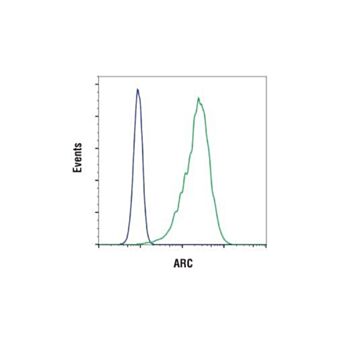
| Size | 100 µl |
| Reactivity | H |
| Sensitivity | Endogenous |
| Molecular Weight (kDa) | 27 |
| Source/Isotype | Rabbit IgG |
| Application/Dilution | {Western Blotting: 1:1000, Immunoprecipitation: 1:100, Immunohistochemistry (Paraffin): 1:400, Immunofluorescence (Immunocytochemistry): 1:1600, Flow Cytometry (Fixed/Permeabilized): 1:100} |
| Storage | Supplied in 10 mM sodium HEPES (pH 7.5), 150 mM NaCl, 100 µg/ml BSA, 50% glycerol and less than 0.02% sodium azide. Store at –20°C. Do not aliquot the antibody. |
| Specificity/Sensitivity | ARC (D7Q3G) Rabbit mAb recognizes endogenous levels of total ARC protein. |
| Species Reactivity | Human |
| Source/Purification | Monoclonal antibody is produced by immunizing animals with a synthetic peptide corresponding to residues surrounding Pro125 of human ARC protein, specific to a region encoded by isoform 2 of the NOL3 gene. |
| Background | Apoptosis repressor with caspase recruitment domain (ARC), also independently identified as muscle-enriched cytoplasmic protein (MYP), is a CARD domain protein that regulates apoptosis (1). The ARC protein CARD domain is highly homologous to those in other cell death regulators, including caspase-2, caspase-9, RAIDD, and Apaf-1 (2). The NOL3 gene encodes both the cytoplasmic ARC protein and a 30 kDa nucleolar protein (Nop30) that is involved in RNA splicing. ARC is encoded from isoform 2 of NOL3, while isoform 1 produced by alternative splicing encodes Nop30. Both ARC and Nop30 proteins share common amino-terminal sequences (3). Research studies show that ARC can bind to caspase-8 and caspase-2 and inhibit apoptosis through extrinsic pathways that involve the receptor proteins Fas, TNFR1, and DR3 (1). Additional research indicates that the ARC anti-apoptotic mechanism may include both intrinsic (mitochondrial) and extrinsic (death receptor) pathways (4). In addition to binding caspases, ARC can disrupt the interaction with the death domains of Fas and FADD, which inhibits death-inducing signaling complex (DISC) assembly. The CARD domain of ARC can inhibit intrinsic apoptosis through binding to the pro-apoptotic Bax protein (5). Phosphorylation of ARC at Thr149 by CK2 is required for targeting of ARC to the mitochondria (6). ARC is able to suppress necroptosis, a programmed pathway of necrosis triggered by blocking the recruitment of RIP1 to TNFR1 (7). Expression of ARC protein is predominantly seen in terminally differentiated cells under normal conditions and is markedly induced in a variety of cancers including pancreatic, colorectal, breast, lung, glioblastoma, liver, kidney, melanoma, and acute myeloid leukemia (1, 8-12). |
| SKU | CSIG-38916S |
|---|---|
| Featured | No |
| Supplier Part Number | 38916S |
| UM | EA |
| UNSPSC | 12352203 |
| Manufacturer | Cell Signaling |
| MSDS URL | Click here |
| Temperature | -20C |
| CountryOfOrigin | United States |
| ProductLine | CSIG |
| Qty | 1 |
| MinOrderQty | 1 |
| Weight | 7.000000 |
| Lead Time | 5 |
| Hazardous | N |
| ACT Ecolabel | No |