We use cookies to make your experience better. To comply with the new e-Privacy directive, we need to ask for your consent to set the cookies. Learn about our cookie policy.

Cell Signaling Phospho-Ampa Receptor 2 (Glua2) (Tyr869/Tyr873/Tyr876) Antibody
List Price
$149.48
Your Price
$149.48
Cell Signaling Phospho-Ampa Receptor 2 (Glua2) (Tyr869/Tyr873/Tyr876) Antibody - CSIG (Additional S&H or Hazmat Fees May Apply)
NETA PART:
CSIG-3921T
MFG.PART:
3921T
UNSPSC:
12352203
Manufacturer:
Cell Signaling


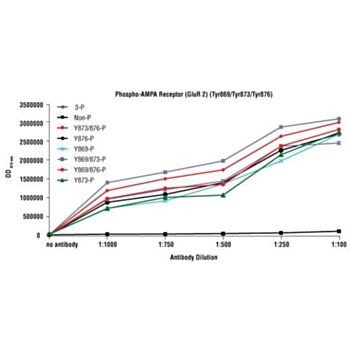
| Size | 20 µl |
| Reactivity | R |
| Sensitivity | Endogenous |
| Molecular Weight (kDa) | 100 |
| Source/Isotype | Rabbit |
| Application/Dilution | {Western Blotting: 1:1000} |
| Storage | Supplied in 10 mm sodium HEPES (pH 7.5), 150 mm NaCl, 100 µg/mL BSA and 50% glycerol. Store at –20°C. Do not aliquot the antibody. |
| Specificity/Sensitivity | Phospho-AMPA Receptor 2 (GluA2) (Tyr869/Tyr873/Tyr876) Antibody detects endogenous levels of GluA2 only when phosphorylated at Tyr869, Tyr873 or Tyr876. It may also detect GluA3 when phosphorylated at the conserved Tyr880, Tyr884 or Tyr887. These residues are not conserved in GluA1 or GluA4. |
| Species Reactivity | Rat |
| Source/Purification | Polyclonal antibodies are produced by immunizing animals with a synthetic phosphopeptide corresponding to residues surrounding Tyr869, Tyr873 and Tyr876 of human AMPA Receptor 2 (GluA2). Antibodies are purified by protein A and peptide affinity chromatography. |
| Background | AMPA- (α-amino-3-hydroxy-5-methyl-4-isoxazolepropionic acid), kainate-, and NMDA- (N-methyl-D-aspartate) receptors are the three main families of ionotropic glutamate-gated ion channels. AMPA receptors (AMPARs) are comprised of four subunits (GluR 1-4), which assemble as homo- or hetero-tetramers to mediate the majority of fast excitatory transmissions in the central nervous system. AMPARs are implicated in synapse formation, stabilization, and plasticity (1). In contrast to GluR 2-containing AMPARs, AMPARs that lack GluR 2 are permeable to calcium (2). Post-transcriptional modifications (alternative splicing, nuclear RNA editing) and post-translational modifications (glycosylation, phosphorylation) result in a very large number of permutations, fine-tuning the kinetic properties of AMPARs. Research studies have implicated activity changes in AMPARs in a variety of diseases including Alzheimer’s, amyotrophic lateral sclerosis (ALS), stroke, and epilepsy (1).Src family tyrosine kinases phosphorylate the GluR 2 subunit of AMPA receptors at Tyr876, which increases the interaction with GRIP1/2 but not PICK1. In addition, Tyr876 is important for AMPA- and NMDA-induced GluR 2 internalization (3).The phosphorylation sites at Tyr869, Tyr873 and Tyr876 were identified at Cell Signaling Technology (CST) using PhosphoScan®, CSTs MS/MS platform for phosphorylation site discovery. Phosphorylation of GluR2 at Tyr869, Tyr873 and Tyr876 was observed in extracts isolated from ischemic rat brain. These sites were independently found in a large-scale identification of tyrosine phosphorylation sites from murine brain (4). |
| SKU | CSIG-3921T |
|---|---|
| Supplier Part Number | 3921T |
| UM | EA |
| UNSPSC | 12352203 |
| Manufacturer | Cell Signaling |
| MSDS URL | Click here |
| Temperature | -20C |
| CountryOfOrigin | United States |
| ProductLine | CSIG |
| Qty | 1 |
| MinOrderQty | 1 |
| Weight | 7.000000 |
| Lead Time | 5 |
| Hazardous | N |
| Energy Star | No |
| Green | No |
| Controlled | N |