We use cookies to make your experience better. To comply with the new e-Privacy directive, we need to ask for your consent to set the cookies. Learn about our cookie policy.

Cell Signaling Phospho-Tuberin/Tsc2 (Ser664) (D3b9z) Rabbit mAb
List Price
$419.15
Your Price
$419.15
Cell Signaling Phospho-Tuberin/Tsc2 (Ser664) (D3b9z) Rabbit mAb - CSIG (Additional S&H or Hazmat Fees May Apply)
NETA PART:
CSIG-40729S
MFG.PART:
40729S
UNSPSC:
12352203
Manufacturer:
Cell Signaling


| Size | 100 µl |
| Reactivity | H |
| Sensitivity | Endogenous |
| Molecular Weight (kDa) | 200 |
| Source/Isotype | Rabbit IgG |
| Application/Dilution | {Western Blotting: 1:1000, Immunoprecipitation: 1:50} |
| Storage | Supplied in 10 mm sodium HEPES (pH 7.5), 150 mm NaCl, 100 µg/mL BSA, 50% glycerol and less than 0.02% sodium azide. Store at –20°C. Do not aliquot the antibody. |
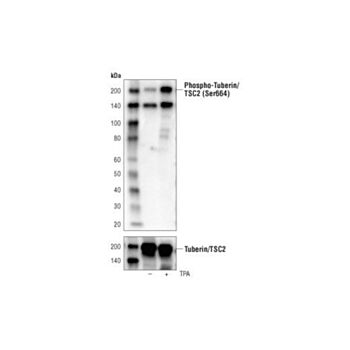
| Specificity/Sensitivity | Phospho-Tuberin/TSC2 (Ser664) (D3B9Z) Rabbit mAb recognizes endogenous levels of Tuberin/TSC2 protein only when phosphorylated at Ser664. This antibody cross-reacts with a 140kD protein of unknown origin. |
| Species Reactivity | Human |
| Source/Purification | Monoclonal antibody is produced by immunizing animals with a synthetic peptide corresponding to residues surrounding Ser664 of human Tuberin/TSC2 protein. |
| Background | Tuberin is a product of the TSC2 tumor suppressor gene and an important regulator of cell proliferation and tumor development (1). Mutations in either TSC2 or the related TSC1 (hamartin) gene cause tuberous sclerosis complex (TSC), an autosomal dominant disorder characterized by development of multiple, widespread non-malignant tumors (2). Tuberin is directly phosphorylated at Thr1462 by Akt/PKB (3). Phosphorylation at Thr1462 and Tyr1571 regulates tuberin-hamartin complexes and tuberin activity (3-5). In addition, tuberin inhibits the mammalian target of rapamycin (mTOR), which promotes inhibition of p70 S6 kinase, activation of eukaryotic initiation factor 4E binding protein 1 (4E-BP1, an inhibitor of translation initiation), and eventual inhibition of translation (3,6,7).p44/42 MAPK (Erk1/2) phosphorylates of TSC2 at Ser664 which leads to TSC1-TSC2 dissociation and considerably decreases the ability of TSC2 to inhibit mTOR signaling, cell proliferation and oncogenic transformation (8,9). Furthermore, studies have indicated that cancer patients with TSC2 phosphorylation at Ser664 may benefit from MAPK and mTOR inhibitors (10). |
| SKU | CSIG-40729S |
|---|---|
| Supplier Part Number | 40729S |
| UM | EA |
| UNSPSC | 12352203 |
| Manufacturer | Cell Signaling |
| MSDS URL | Click here |
| Temperature | -20C |
| CountryOfOrigin | United States |
| ProductLine | CSIG |
| Qty | 1 |
| MinOrderQty | 1 |
| Weight | 7.000000 |
| Lead Time | 5 |
| Hazardous | N |
| Energy Star | No |
| Green | No |
| Controlled | N |