We use cookies to make your experience better. To comply with the new e-Privacy directive, we need to ask for your consent to set the cookies. Learn about our cookie policy.

Cell Signaling Slk Antibody
List Price $320.17 Your Price $320.17
Cell Signaling Slk Antibody - CSIG (Additional S&H or Hazmat Fees May Apply)
NETA PART: CSIG-41255S
MFG.PART: 41255S
UNSPSC: 12352203
Manufacturer: Cell Signaling


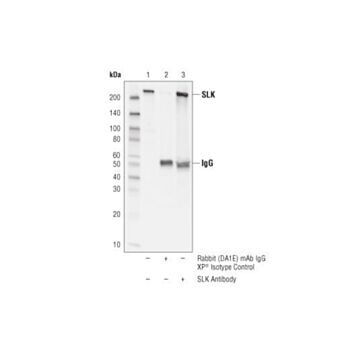
| Size | 100 µl |
| Reactivity | H |
| Sensitivity | Endogenous |
| Molecular Weight (kDa) | 220 |
| Source/Isotype | Rabbit |
| Application/Dilution | {Western Blotting: 1:1000, Immunoprecipitation: 1:50} |
| Storage | Supplied in 10 mm sodium HEPES (pH 7.5), 150 mm NaCl, 100 µg/mL BSA and 50% glycerol. Store at –20°C. Do not aliquot the antibody. |
| Specificity/Sensitivity | SLK antibody recognizes endogenous levels of total SLK protein. |
| Species Reactivity | Human |
| Source/Purification | Polyclonal antibodies are produced by immunizing animals with a synthetic peptide corresponding to residues surrounding Glu431 of human SLK protein. |
| Background | SLK (Ste20-like Kinase) is a member of the germinal center kinase (GCK) family of proteins. SLK has a kinase domain located at the N terminus (1). The autophosphorylation of SLK at Thr183 and Ser189 is required for the upregulation of SLK kinase activity (1, 2). The protein also has a caspase cleavage site DXXD and a SH3 binding site PXXP located in the middle part of its sequence, and a regulatory C terminal coiled-coil domain for homodimerization and adaptor binding (1-4). SLK plays important roles in development, tissue regeneration and cancer cell migration by regulating several signaling pathways (5-7). SLK phosphorylates and activates ASK1 to induce downstream p38 phosphorylation and apoptosis (8,9). During cell cycle, SLK phosphorylates Polo-like kinase (PLK) at Thr210 to promote G2/M transition (10,11). SLK also promotes cell division by direct phosphorylation of ERMs and dynactin to activate microtubule reorganization and spindle orientation (12, 13). During focal adhesion and cell migration process, SLK is activated and colocalized to the focal adhesion complex where it promotes complex turnover by phosphorylating paxillin at Ser250 (14, 15). |
| SKU | CSIG-41255S |
|---|---|
| Supplier Part Number | 41255S |
| UM | EA |
| UNSPSC | 12352203 |
| Manufacturer | Cell Signaling |
| MSDS URL | Click here |
| Temperature | -20C |
| CountryOfOrigin | United States |
| ProductLine | CSIG |
| Qty | 1 |
| MinOrderQty | 1 |
| Weight | 7.000000 |
| Lead Time | 5 |
| Hazardous | N |
| Energy Star | No |
| Green | No |
| Controlled | N |