We use cookies to make your experience better. To comply with the new e-Privacy directive, we need to ask for your consent to set the cookies. Learn about our cookie policy.

Cell Signaling Ubiquityl-Histone H2a (Lys119) (D27c4) Xp Rabbit mAb (PE Conjugate)
List Price $497.93 Your Price $497.93
Cell Signaling Ubiquityl-Histone H2a (Lys119) (D27c4) Xp Rabbit mAb (PE Conjugate) - CSIG (Additional S&H or Hazmat Fees May Apply)
NETA PART: CSIG-41475S
MFG.PART: 41475S
UNSPSC: 12352203
Manufacturer: Cell Signaling


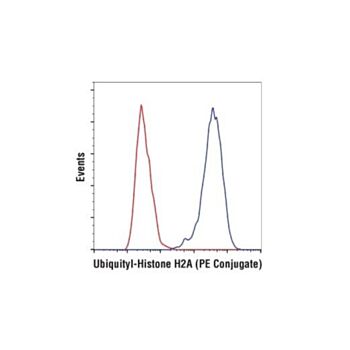
| Size | 100 µl (50 tests) |
| Reactivity | H M R Mk |
| Sensitivity | Endogenous |
| Source/Isotype | Rabbit IgG |
| Application/Dilution | {Flow Cytometry (Fixed/Permeabilized): 1:50} |
| Storage | Supplied in PBS (pH 7.2), less than 0.1% sodium azide and 2 mg/mL BSA. Store at 4°C. Do not aliquot the antibody. Protect from light. Do not freeze. |
| Specificity/Sensitivity | Ubiquityl-Histone H2A (Lys119) (D27C4) XP® Rabbit mAb (PE Conjugate) recognizes endogenous levels of histone H2A protein only when ubiquitinated at Lys119. The antibody does not cross-react with other ubiquitinated proteins or free ubiquitin. |
| Species Reactivity | Human, Mouse, Rat, Monkey |
| Source/Purification | Monoclonal antibody is produced by immunizing animals with a synthetic peptide corresponding to residues near the carboxy terminus of human histone H2A protein in which Lys119 is mono-ubiquitinated. |
| Background | The nucleosome, made up of four core histone proteins (H2A, H2B, H3, and H4), is the primary building block of chromatin. Originally thought to function as a static scaffold for DNA packaging, histones have now been shown to be dynamic proteins, undergoing multiple types of posttranslational modifications, including acetylation, phosphorylation, methylation, and ubiquitination (1). Ubiquitin is a conserved 76 amino acid peptide unit that can be covalently linked to many cellular proteins by the ubiquitination process. Three components are involved in this protein-ubiquitin conjugation process. Ubiquitin is first activated by forming a thioester complex with the activation component E1; the activated ubiquitin is subsequently transferred to the ubiquitin-carrier protein E2, then from E2 to ubiquitin ligase E3 for final delivery to the epsilon-NH2 of the target protein lysine residue (2). Histone H2A is mono-ubiquitinated at Lys119 by the Polycomb Repressor Complex 1 (PRC1) and is critical for transcriptional silencing of the developmental HOX genes and X chromosome inactivation (3-6). PRC1 is composed of Bmi1 and RING1A (also RING1 or RNF1), both of which act to enhance the E3 ubiquitin ligase activity of the catalytic subunit RING1B (also RING2 or RNF2) (3,4). Histone H2A is also mono-ubiquitinated at Lys119 at sites of DNA damage. This mono-ubiquitination event requires the PRC1 components Bmi1 and RING1B, in addition to another E3 ubiquitin ligase RNF8, and contributes to subsequent recruitment of the BRCA1 complex, via binding of RAP80/UIMC1 (ubiquitin interactive motif containing 1 protein) (7-10). |
| SKU | CSIG-41475S |
|---|---|
| Supplier Part Number | 41475S |
| UM | EA |
| UNSPSC | 12352203 |
| Manufacturer | Cell Signaling |
| MSDS URL | Click here |
| Temperature | +4C |
| CountryOfOrigin | United States |
| ProductLine | CSIG |
| Qty | 1 |
| MinOrderQty | 1 |
| Weight | 7.000000 |
| Lead Time | 5 |
| Hazardous | N |
| Energy Star | No |
| Green | No |
| Controlled | N |