We use cookies to make your experience better. To comply with the new e-Privacy directive, we need to ask for your consent to set the cookies. Learn about our cookie policy.

Cell Signaling Traf5 (D3e2r) Rabbit mAb
List Price $354.51 Your Price $354.51
Cell Signaling Traf5 (D3e2r) Rabbit mAb - CSIG (Additional S&H or Hazmat Fees May Apply)
NETA PART: CSIG-41658S
MFG.PART: 41658S
UNSPSC: 12352203
Manufacturer: Cell Signaling


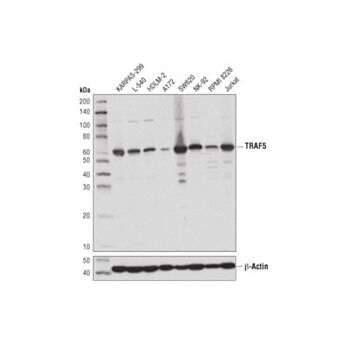
| Size | 100 µl |
| Reactivity | H |
| Sensitivity | Endogenous |
| Molecular Weight (kDa) | 64 |
| Source/Isotype | Rabbit IgG |
| Application/Dilution | {Western Blotting: 1:1000} |
| Storage | Supplied in 10 mm sodium HEPES (pH 7.5), 150 mm NaCl, 100 µg/mL BSA, 50% glycerol and less than 0.02% sodium azide. Store at –20°C. Do not aliquot the antibody. |
| Specificity/Sensitivity | TRAF5 (D3E2R) Rabbit mAb recognizes endogenous levels of total TRAF5 protein. |
| Species Reactivity | Human |
| Source/Purification | Monoclonal antibody is produced by immunizing animals with a synthetic peptide corresponding to residues surrounding His383 of human TRAF5 protein. |
| Background | TRAFs (TNF receptor-associated factors) are a family of multifunctional adaptor proteins that bind to surface receptors and recruit additional proteins to form multiprotein signaling complexes capable of promoting cellular responses (1-3). Members of the TRAF family share a common carboxy-terminal "TRAF domain", which mediates interactions with associated proteins; many also contain amino-terminal Zinc/RING finger motifs. The first TRAFs identified, TRAF1 and TRAF2, were found by virtue of their interactions with the cytoplasmic domain of TNF-receptor 2 (TNFRII) (4). The six known TRAFs (TRAF1-6) act as adaptor proteins for a wide range of cell surface receptors and participate in the regulation of cell survival, proliferation, differentiation, and stress responses.TRAF5 regulates signaling through binding to the cytoplasmic domains of TNFR famly members including CD40, CD27, CD30, OX40, and lymphotoxin-β receptor (5-10). Overexpression of TRAF5 induces NF-κB activation. Cytoplasmic aggregates of TRAF5, as well as TRAF2, were reported in Hodgkin-Reed-Sternberg cells, resulting in constitutive NF-κB activation (11).Studies of TRAF5 deficient mice suggest that it plays an important role in limiting Th2 immune responses that triggers T-cell mediated inflammatory diseases and asthma (12). Further studies indicate that TRAF5 binds to the IL-6 receptor gp130 and negatively controls Th17 differentation (13). In B-cells, TRAF5 negatively regulates toll-like receptor (TLR) mediated cytokine and antibody production (14). |
| SKU | CSIG-41658S |
|---|---|
| Supplier Part Number | 41658S |
| UM | EA |
| UNSPSC | 12352203 |
| Manufacturer | Cell Signaling |
| MSDS URL | Click here |
| Temperature | -20C |
| CountryOfOrigin | United States |
| ProductLine | CSIG |
| Qty | 1 |
| MinOrderQty | 1 |
| Weight | 7.000000 |
| Lead Time | 5 |
| Hazardous | N |
| Energy Star | No |
| Green | No |
| Controlled | N |