We use cookies to make your experience better. To comply with the new e-Privacy directive, we need to ask for your consent to set the cookies. Learn more.

Cell Signaling Pd-1 (Eh33) Mouse mAb (Ihc-Specific)
List Price
$458.54
Your Price
$458.54
Cell Signaling Pd-1 (Eh33) Mouse mAb (Ihc-Specific) - CSIG (Additional S&H or Hazmat Fees May Apply)
NETA PART:
CSIG-43248S
MFG.PART:
43248S
UNSPSC:
12352203
Manufacturer:
Cell Signaling


| Size | 100 µl |
| Reactivity | H |
| Sensitivity | Endogenous |
| Source/Isotype | Mouse IgG2a |
| Application/Dilution | {IHC Leica Bond: 1:100, Immunohistochemistry (Paraffin): 1:200} |
| Storage | Supplied in 10 mM sodium HEPES (pH 7.5), 150 mM NaCl, 100 µg/ml BSA, 50% glycerol and less than 0.02% sodium azide. Store at –20°C. Do not aliquot the antibody. For a carrier-free (BSA and Azide) version of this product see product #60847. |
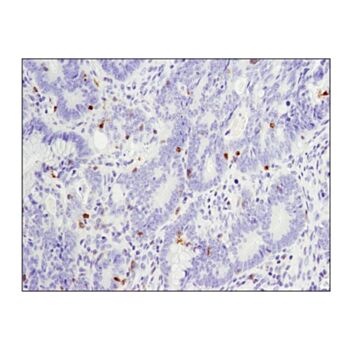
| Specificity/Sensitivity | PD-1 (EH33) Mouse mAb recognizes transfected and endogenous levels of total PD-1 protein by immunohistochemistry on formalin-fixed paraffin-embedded tissue sections. |
| Species Reactivity | Human |
| Source/Purification | Monoclonal antibody is produced by immunizing animals with recombinant protein specific to the amino terminus of human PD-1 protein. |
| Background | The programmed cell death 1 protein (PD-1, PDCD1, CD279) is a member of the CD28 family of immunoreceptors that regulate T cell activation and immune responses (1-3). The PD-1 protein contains an extracellular Ig V domain, a transmembrane domain, and a cytoplasmic tail that includes an immunoreceptor tyrosine-based inhibitory motif (ITIM) and an immunoreceptor tyrosine-based switch motif (ITSM). PD-1 is activated by the cell surface ligands PD-L1 and PD-L2 (4). Upon activation, PD-1 ITIM and ITSM phosphorylation leads to the recruitment of the protein tyrosine phosphatases SHP-1 and SHP-2, which suppress TCR signaling (5-7). In addition to activated T cells, PD-1 is expressed in activated B cells and monocytes, although its function in these cell types has not been fully characterized (8). The PD-1 pathway plays an important role in immune tolerance (3); however, research studies show that cancer cells often adopt this pathway to escape immune surveillance (9). Consequently, blockade of PD-1 and its ligands is proving to be a sound strategy for neoplastic intervention (10). |
| SKU | CSIG-43248S |
|---|---|
| Featured | No |
| Supplier Part Number | 43248S |
| UM | EA |
| UNSPSC | 12352203 |
| Manufacturer | Cell Signaling |
| MSDS URL | Click here |
| Temperature | -20C |
| CountryOfOrigin | United States |
| ProductLine | CSIG |
| Qty | 1 |
| MinOrderQty | 1 |
| Weight | 7.000000 |
| Lead Time | 5 |
| Hazardous | N |
| ACT Ecolabel | No |