We use cookies to make your experience better. To comply with the new e-Privacy directive, we need to ask for your consent to set the cookies. Learn about our cookie policy.

Cell Signaling Chd5 (D2f9q) Rabbit mAb
List Price
$354.51
Your Price
$354.51
Cell Signaling Chd5 (D2f9q) Rabbit mAb - CSIG (Additional S&H or Hazmat Fees May Apply)
NETA PART:
CSIG-44829S
MFG.PART:
44829S
UNSPSC:
12352203
Manufacturer:
Cell Signaling


| Size | 100 µl |
| Reactivity | H |
| Sensitivity | Endogenous |
| Molecular Weight (kDa) | 220 |
| Source/Isotype | Rabbit IgG |
| Application/Dilution | {Western Blotting: 1:1000, Immunoprecipitation: 1:200, Immunohistochemistry (Paraffin): 1:100} |
| Storage | Supplied in 10 mm sodium HEPES (pH 7.5), 150 mm NaCl, 100 µg/mL BSA, 50% glycerol and less than 0.02% sodium azide. Store at –20°C. Do not aliquot the antibody. |
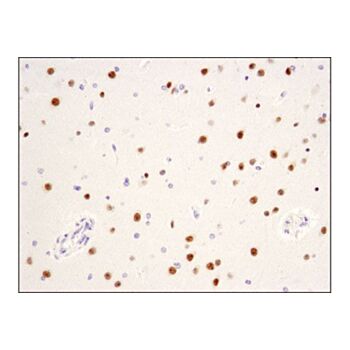
| Specificity/Sensitivity | CHD5 (D2F9Q) Rabbti mAb recognizes endogenous levels of total CHD5 protein. |
| Species Reactivity | Human |
| Source/Purification | Monoclonal antibody is produced by immunizing animals with a synthetic peptide corresponding to residues surrounding Gly1564 of human CHD5 protein. |
| Background | CHD5 (chromodomain-helicase-DNA-binding-5) is one of the 9 known CHD proteins and is homologous to its family members, CHD3 and CHD4 (1-3). CHD5 interacts with the nucleosome remodeling and deacetylation (NuRD) complex (1,4). CHD5 is characterized by two PHD domains, two chromo domains, a SNF2-like helicase/ATPase domain, as well as a conserved coiled-coil motif in the C-terminal region (1). CHD5 binds to the N-terminus of Histone H3 via its PHD domains (1). CHD5 was first characterized as a tumor suppressor gene found to be frequently lost in neuroblastomas (1). Since its initial discovery, CHD5 has been studied extensively and has been implicated in numerous other cancers including gliomas, breast, lung, ovarian, and prostate cancers as well as in laryngeal squamous cell carcinomas and gallbladder carcinoma (1). CHD5 is thought to be a prognostic marker in neuroblastoma patients. High CHD5 levels are strongly correlated with favorable clinical outcomes, whereas low or absent expression is associated with MYCN amplification and poor outcomes (1). In addition, CHD5 has a dual function in neurogenesis, playing a transcription activating role in neurogenesis, while interacting with the Polycomb group proteins to repress genes encoding regulators of other lineages. Deletion of CHD5 also inhibits neuronal differentiation leading to the accumulation of undifferentiated progenitors (5). |
| SKU | CSIG-44829S |
|---|---|
| Supplier Part Number | 44829S |
| UM | EA |
| UNSPSC | 12352203 |
| Manufacturer | Cell Signaling |
| MSDS URL | Click here |
| Temperature | -20C |
| CountryOfOrigin | United States |
| ProductLine | CSIG |
| Qty | 1 |
| MinOrderQty | 1 |
| Weight | 7.000000 |
| Lead Time | 5 |
| Hazardous | N |
| Energy Star | No |
| Green | No |
| Controlled | N |