We use cookies to make your experience better. To comply with the new e-Privacy directive, we need to ask for your consent to set the cookies. Learn about our cookie policy.

Cell Signaling Ampa Receptor 3 (Glua 3) (D47e3) Rabbit mAb
List Price $152.51 Your Price $152.51
Cell Signaling Ampa Receptor 3 (Glua 3) (D47e3) Rabbit mAb - CSIG (Additional S&H or Hazmat Fees May Apply)
NETA PART: CSIG-4676T
MFG.PART: 4676T
UNSPSC: 12352203
Manufacturer: Cell Signaling


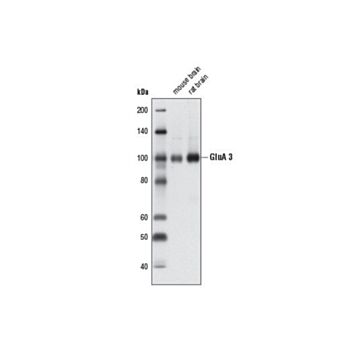
| Size | 20 µl |
| Reactivity | H M R |
| Sensitivity | Endogenous |
| Molecular Weight (kDa) | 100 |
| Source/Isotype | Rabbit IgG |
| Application/Dilution | {Western Blotting: 1:2000, Immunoprecipitation: 1:50} |
| Storage | Supplied in 10 mm sodium HEPES (pH 7.5), 150 mm NaCl, 100 µg/mL BSA, 50% glycerol and less than 0.02% sodium azide. Store at –20°C. Do not aliquot the antibody. |
| Specificity/Sensitivity | AMPA Receptor 3 (GluA 3) (D47E3) Rabbit mAb detects endogenous levels of total GluA 3 protein. The antibody is not predicted to detect other AMPA receptor subunits (e.g. GluA 1, GluA 2 or GluA 4) based on sequence homology of the antigen. |
| Species Reactivity | Human, Mouse, Rat |
| Source/Purification | Monoclonal antibody is produced by immunizing animals with a synthetic peptide corresponding to residues surrounding Pro590 of human GluA 3 protein. |
| Background | AMPA- (α-amino-3-hydroxy-5-methyl-4-isoxazolepropionic acid), kainite- and NMDA- (N-methyl-D-aspartate) receptors are the three main families of ionotropic glutamate-gated ion channels. AMPA receptors (AMPARs) are comprised of four subunits (GluR 1-4) that assemble as homo- or hetero-tetramers and mediate the majority of fast excitatory transmissions in the CNS. AMPARs are implicated in synapse formation, stabilization and plasticity. Post-transcriptional modifications (alternative splicing and nuclear RNA editing) and post-translational modifications (glycosylation, phoshorylation) result in a very large number of permutations, fine-tuning the kinetic properties of AMPARs (1). GluR 3 knockout mice exhibited normal basal synaptic transmission and long-term depression (LTD) but enhanced long-term potentiation (LTP). In contrast, GluR 2/3 double knockout mice are impaired in basal synaptic transmission (2). Aberrant GluR 3 expression or activity is implicated in a number of diseases, including autoimmune epilepsy, X-linked mental retardation, Retts syndrome, amyotrophic lateral sclerosis and Alzheimer disease (3). |
| SKU | CSIG-4676T |
|---|---|
| Supplier Part Number | 4676T |
| UM | EA |
| UNSPSC | 12352203 |
| Manufacturer | Cell Signaling |
| MSDS URL | Click here |
| Temperature | -20C |
| CountryOfOrigin | United States |
| ProductLine | CSIG |
| Qty | 1 |
| MinOrderQty | 1 |
| Weight | 7.000000 |
| Lead Time | 5 |
| Hazardous | N |
| Energy Star | No |
| Green | No |
| Controlled | N |