We use cookies to make your experience better. To comply with the new e-Privacy directive, we need to ask for your consent to set the cookies. Learn about our cookie policy.

Cell Signaling Ubc3 Antibody
List Price $137.36 Your Price $137.36
Cell Signaling Ubc3 Antibody - CSIG (Additional S&H or Hazmat Fees May Apply)
NETA PART: CSIG-4997T
MFG.PART: 4997T
UNSPSC: 12352203
Manufacturer: Cell Signaling


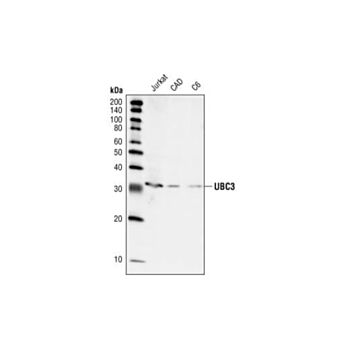
| Size | 20 µl |
| Reactivity | H M R |
| Sensitivity | Endogenous |
| Molecular Weight (kDa) | 32 |
| Source/Isotype | Rabbit |
| Application/Dilution | {Western Blotting: 1:1000} |
| Storage | Supplied in 10 mm sodium HEPES (pH 7.5), 150 mm NaCl, 100 µg/mL BSA and 50% glycerol. Store at –20°C. Do not aliquot the antibody. |
| Specificity/Sensitivity | UBC3 Antibody detects endogenous levels of total UBC3 and UBC3B protein. |
| Species Reactivity | Human, Mouse, Rat |
| Source/Purification | Polyclonal antibodies are produced by immunizing animals with a synthetic peptide corresponding to the sequence of human UBC3. Antibodies are purified by protein A and peptide affinity chromatography. |
| Background | Ubiquitin can be covalently linked to many cellular proteins by the ubiquitination process, which targets proteins for degradation by the 26S proteasome. Three components are involved in the target protein-ubiquitin conjugation process. Ubiquitin is first activated by forming a thiolester complex with the activation component E1; the activated ubiquitin is subsequently transferred to the ubiquitin-carrier protein E2, and then from E2 to ubiquitin ligase E3 for final delivery to the epsilon-NH2 of the target protein lysine residue (1-3). Combinatorial interactions of different E2 and E3 proteins result in substrate specificity (4). Recent data suggest that activated E2 associates transiently with E3, and that the dissociation is a critical step for ubiqitination (5). UBC3, the mammalian orthologue of yeast Cdc34, and UBC3B, a UBC3 family member, are E2 ubiquitin-carrier proteins. These proteins contain a conserved core domain containing a cysteine residue, which forms the thioester bond with ubiquitin (6). UBC3 in concert with the SCFSkp2 (Skp1, Cullin and F-box protein/Skp2) complex mediates cell cycle progression from G1 to S phase by targeting the CDK inhibitor p27 for proteolysis (7). UBC3B in concert with the SCFb-Trcp (Skp1, Cullin and F-box protein/b-Trcp) complex mediates degradation of b-catenin (6). |
| SKU | CSIG-4997T |
|---|---|
| Supplier Part Number | 4997T |
| UM | EA |
| UNSPSC | 12352203 |
| Manufacturer | Cell Signaling |
| MSDS URL | Click here |
| Temperature | -20C |
| CountryOfOrigin | United States |
| ProductLine | CSIG |
| Qty | 1 |
| MinOrderQty | 1 |
| Weight | 7.000000 |
| Lead Time | 5 |
| Hazardous | N |
| Energy Star | No |
| Green | No |
| Controlled | N |