We use cookies to make your experience better. To comply with the new e-Privacy directive, we need to ask for your consent to set the cookies. Learn about our cookie policy.

Cell Signaling Akap1 (D9c5) Xp Rabbit mAb
List Price $160.59 Your Price $160.59
Cell Signaling Akap1 (D9c5) Xp Rabbit mAb - CSIG (Additional S&H or Hazmat Fees May Apply)
NETA PART: CSIG-5203T
MFG.PART: 5203T
UNSPSC: 12352203
Manufacturer: Cell Signaling


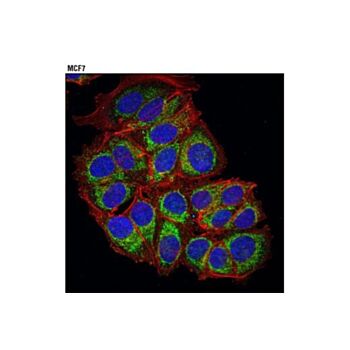
| Size | 20 µl |
| Reactivity | H M R |
| Sensitivity | Endogenous |
| Molecular Weight (kDa) | 149 (H), 130 (M), 121 (R) |
| Source/Isotype | Rabbit IgG |
| Application/Dilution | {Western Blotting: 1:1000, Immunoprecipitation: 1:50} |
| Storage | Supplied in 10 mm sodium HEPES (pH 7.5), 150 mm NaCl, 100 µg/mL BSA, 50% glycerol and less than 0.02% sodium azide. Store at –20°C. Do not aliquot the antibody. |
| Specificity/Sensitivity | AKAP1 (D9C5) Rabbit mAb recognizes endogenous levels of total AKAP1 protein. |
| Species Reactivity | Human, Mouse, Rat |
| Source/Purification | Monoclonal antibody is produced by immunizing animals with a synthetic peptide corresponding to residues surrounding Val630 of human AKAP1 protein. |
| Background | AKAPs (A-kinase anchoring proteins), as their name implies, are a family of scaffolding proteins that bind regulatory subunits of Protein Kinase A (PKA) thus localizing PKA activity to distinct regions of the cell (1). Beyond a common amphipathic alpha-helix which is responsible for recruiting the PKA regulatory subunit (RIα, RIIα, RIβ, or RIIβ), individual AKAPs contain additional domains responsible for the recruitment of additional signaling proteins (phosphodiesterases, phosphatases, cytoskeletal components, other kinases, etc.) or restricting the AKAP to a specific subcellular location (1). AKAP1, also known as AKAP149 in human, AKAP121 in rat, or D-AKAP in mouse is a dual-specificity AKAP which can bind to both RI and RII subunits of PKA with similar affinity (2,3). Originally thought to be predominantly restricted to the mitochondria, growing evidence suggests that localization of AKAP1 can be regulated in part by alternative splicing events and that AKAP1 may be present in the endoplasmic reticulum-nuclear envelope membrane network (4-6). Peri-nuclear localization, along with the fact that AKAP1 interacts with RNA via one of two nucleotide-binding domains (K homology (KH) and Tudor) have lead some to suggest that AKAP1 may play a role in RNA metabolism (7,8). In addition to PKA-RI and -RII, AKAP1 directly interacts with PP1 in a phosphorylation dependent manner and nucleates a complex containing PP2Ac, PKA and RSK1 which modulates RSK1 localization and activity (9-12). |
| SKU | CSIG-5203T |
|---|---|
| Supplier Part Number | 5203T |
| UM | EA |
| UNSPSC | 12352203 |
| Manufacturer | Cell Signaling |
| MSDS URL | Click here |
| Temperature | -20C |
| CountryOfOrigin | United States |
| ProductLine | CSIG |
| Qty | 1 |
| MinOrderQty | 1 |
| Weight | 7.000000 |
| Lead Time | 5 |
| Hazardous | N |
| Energy Star | No |
| Green | No |
| Controlled | N |