We use cookies to make your experience better. To comply with the new e-Privacy directive, we need to ask for your consent to set the cookies. Learn about our cookie policy.

Cell Signaling Jmjd1b (6a1-1f5) Mouse mAb
List Price $149.48 Your Price $149.48
Cell Signaling Jmjd1b (6a1-1f5) Mouse mAb - CSIG (Additional S&H or Hazmat Fees May Apply)
NETA PART: CSIG-5377T
MFG.PART: 5377T
UNSPSC: 12352203
Manufacturer: Cell Signaling


| Size | 20 µl |
| Reactivity | H M R Mk |
| Sensitivity | Endogenous |
| Molecular Weight (kDa) | 220 |
| Source/Isotype | Mouse IgG1 |
| Application/Dilution | {Western Blotting: 1:1000, Immunoprecipitation: 1:50, Immunofluorescence (Immunocytochemistry): 1:200} |
| Storage | Supplied in 10 mm sodium HEPES (pH 7.5), 150 mm NaCl, 100 µg/mL BSA, 50% glycerol and less than 0.02% sodium azide. Store at –20°C. Do not aliquot the antibody. |
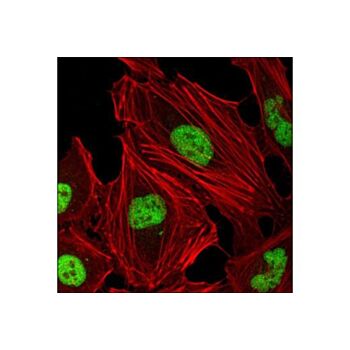
| Specificity/Sensitivity | JMJD1B (6A1-1F5) Mouse mAb detects endogenous levels of total JMJD1B protein. |
| Species Reactivity | Human, Mouse, Rat, Monkey |
| Source/Purification | Monoclonal antibody is produced by immunizing animals with a recombinant protein corresponding to the sequence of human JMJD1B. |
| Background | The methylation state of lysine residues in histone proteins is a major determinant of the formation of active and inactive regions of the genome and is crucial for the proper programming of the genome during development (1,2). Jumonji C (JmjC) domain-containing proteins represent the largest class of potential histone demethylase proteins (3). The JmjC domain of several proteins has been shown to catalyze the demethylation of mono-, di-, and tri-methyl lysine residues via an oxidative reaction that requires iron and α-ketoglutarate (3). Based on homology, both humans and mice contain at least 30 such proteins, which can be divided into seven separate families (3). The JMJD1 (Jumonji domain-containing protein 1) family, also known as JHDM2 (JmjC domain-containing histone demethylation protein 2) family, contains four members: hairless (HR), JMJD1A/JHDM2A, JMJD1B/JHDM2B, and JMJD1C/JHDM2C. Hairless is expressed in the skin and brain and acts as a co-repressor of the thyroid hormone receptor (4-6). Mutations in the hairless gene cause alopecia in both mice and humans (4,5). JMJD1A is expressed in meiotic and post-meiotic male germ cells, contributes to androgen receptor-mediated gene regulation, and is required for spermatogenesis (7-9). It has also been identified as a downstream target of OCT4 and STAT3 and is critical for the regulation of self-renewal in embryonic stem cells (10,11). JMJD1B is a more widely expressed family member and is frequently deleted in myeloid leukemia (12). JMJD1C (also known as TRIP8) is a co-factor of both the androgen and thyroid receptors and has a potential link to autism (13-15). Members of the JMJD1/JHDM2 family have been shown to demethylate mono-methyl and di-methyl histone H3 (Lys9) (3,8). |
| SKU | CSIG-5377T |
|---|---|
| Supplier Part Number | 5377T |
| UM | EA |
| UNSPSC | 12352203 |
| Manufacturer | Cell Signaling |
| MSDS URL | Click here |
| Temperature | -20C |
| CountryOfOrigin | United States |
| ProductLine | CSIG |
| Qty | 1 |
| MinOrderQty | 1 |
| Weight | 7.000000 |
| Lead Time | 5 |
| Hazardous | N |
| Energy Star | No |
| Green | No |
| Controlled | N |