We use cookies to make your experience better. To comply with the new e-Privacy directive, we need to ask for your consent to set the cookies. Learn more.

Cell Signaling Ubiquityl-Histone H2b (Lys120) (D11) Xp Rabbit mAb
List Price
$175.74
Your Price
$175.74
Cell Signaling Ubiquityl-Histone H2b (Lys120) (D11) Xp Rabbit mAb - CSIG (Additional S&H or Hazmat Fees May Apply)
NETA PART:
CSIG-5546T
MFG.PART:
5546T
UNSPSC:
12352203
Manufacturer:
Cell Signaling


| Size | 20 µl |
| Reactivity | H M R Mk |
| Sensitivity | Endogenous |
| Molecular Weight (kDa) | 23 |
| Source/Isotype | Rabbit IgG |
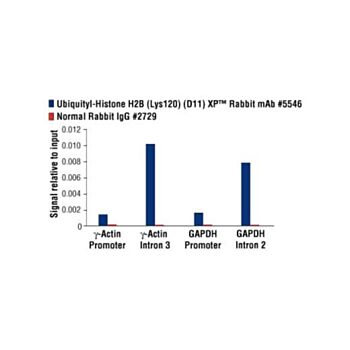
| Application/Dilution | {Western Blotting: 1:1000, Immunofluorescence (Immunocytochemistry): 1:800 - 1:3200, Flow Cytometry (Fixed/Permeabilized): 1:400 - 1:1600, Chromatin IP: 1:200, Chromatin IP-seq: 1:200} |
| Storage | Supplied in 10 mM sodium HEPES (pH 7.5), 150 mM NaCl, 100 µg/ml BSA, 50% glycerol and less than 0.02% sodium azide. Store at –20°C. Do not aliquot the antibody. |
| Specificity/Sensitivity | Ubiquityl-Histone H2B (Lys120) (D11) XP® Rabbit mAb detects endogenous levels of histone H2B protein only when ubiquitylated on Lys120. The antibody does not cross-react with other ubiquitylated proteins or free ubiquitin. |
| Species Reactivity | Human, Mouse, Rat, Monkey |
| Source/Purification | Monoclonal antibody is produced by immunizing animals with a synthetic peptide corresponding to the carboxy terminus of the human histone H2B protein in which Lys120 is mono-ubiquitylated. |
| Background | The nucleosome, made up of four core histone proteins (H2A, H2B, H3 and H4), is the primary building block of chromatin. Originally thought to function as a static scaffold for DNA packaging, histones have now been shown to be dynamic proteins, undergoing multiple types of post-translational modifications, including acetylation, phosphorylation, methylation, and ubiquitylation (1). Ubiquitin is a conserved 76 amino acid peptide unit that can be covalently linked to many cellular proteins by the ubiquitylation process. Three components are involved in this protein-ubiquitin conjugation process. Ubiquitin is first activated by forming a thiolester complex with the activation component E1; the activated ubiquitin is subsequently transferred to the ubiquitin-carrier protein E2, then from E2 to ubiquitin ligase E3 for final delivery to the epsilon-NH2 of the target protein lysine residue (2). Histone H2B is mono-ubiquitylated on lysine 120 during transcriptional activation by the RAD6 E2 protein in conjunction with the BRE1A/BRE1B E3 ligase (also known as RNF20/RNF40) (3). The RAD6/BRE1 complex is recruited to gene promoters during activation by the PAF complex, an RNA polymerase II-associated protein complex that regulates transcriptional elongation (3-5). Mono-ubiquitylated histone H2B lysine 120 is associated with the transcribed region of active genes (3,6). Mono-ubiquitylation of histone H2B stimulates transcriptional elongation by facilitating FACT-dependent chromatin remodeling (7,8). In addition, it is essential for subsequent methylation of histone H3 lysines 4 and 79, two additional histone modifications that regulate transcriptional initiation and elongation (9). Interestingly, de-ubiquitylation of histone H2B lysine 120 by USP22, a subunit of the human SAGA histone acetyltransferase complex, is a required step in transcriptional activation (10). Thus, it appears that the ubiquitylation state of histone H2B is dynamic during transcription and may serve as an intermediate step in transcriptional activation. |
| SKU | CSIG-5546T |
|---|---|
| Featured | No |
| Supplier Part Number | 5546T |
| UM | EA |
| UNSPSC | 12352203 |
| Manufacturer | Cell Signaling |
| MSDS URL | Click here |
| Temperature | -20C |
| CountryOfOrigin | United States |
| ProductLine | CSIG |
| Qty | 1 |
| MinOrderQty | 1 |
| Weight | 7.000000 |
| Lead Time | 5 |
| Hazardous | N |
| ACT Ecolabel | No |