We use cookies to make your experience better. To comply with the new e-Privacy directive, we need to ask for your consent to set the cookies. Learn about our cookie policy.

Cell Signaling A20/Tnfaip3 (D13h3) Rabbit mAb
List Price
$150.49
Your Price
$150.49
Cell Signaling A20/Tnfaip3 (D13h3) Rabbit mAb - CSIG (Additional S&H or Hazmat Fees May Apply)
NETA PART:
CSIG-5630T
MFG.PART:
5630T
UNSPSC:
12352203
Manufacturer:
Cell Signaling


| Size | 20 µl |
| Reactivity | H M R Mk |
| Sensitivity | Endogenous |
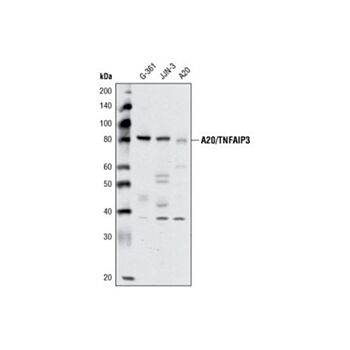
| Molecular Weight (kDa) | 82 |
| Source/Isotype | Rabbit IgG |
| Application/Dilution | {Western Blotting: 1:1000, Immunoprecipitation: 1:100} |
| Storage | Supplied in 10 mm sodium HEPES (pH 7.5), 150 mm NaCl, 100 µg/mL BSA, 50% glycerol and less than 0.02% sodium azide. Store at –20°C. Do not aliquot the antibody. |
| Specificity/Sensitivity | A20/TNFAIP3 (D13H3) Rabbit mAb recognizes endogenous levels of total A20/TNFAIP3 protein. |
| Species Reactivity | Human, Mouse, Rat, Monkey |
| Source/Purification | Monoclonal antibody is produced by immunizing animals with recombinant protein specific to the amino terminus terminus of human A20/TNFAIP3 protein. The antibody was prepared in collaboration with Dr. Marc Schmidt-Supprian, Max Planck Institute of Biochemistry. |
| Background | A20, also referred to as TNF-α-induced protein 3 (TNFAIP3), is cytokine-inducible protein that functions to inhibit apoptosis and activate NF-κB (1,2). It was first identified as a TNF-α inducible primary response gene in human umbilical vein endothelial cells, and encodes a 790-amino acid protein containing seven Cys2/Cys2-zinc finger motifs (3). Constitutive expression of A20 is observed in lymphoid tissues (4), but it is transiently expressed in a variety of cell types in response to inflammatory signals such as TNF-α (3,5), IL-1 (3,5), phorbol esters (6), and LPS (7). Expression of A20 can confer resistance to apoptosis and NF-κB activation triggered by these signals, probably through interference with TRAF (TNF receptor associated factor) family members (8,9), and interaction with the NF-κB inhibiting protein ABIN (10). Studies also show that A20 contains site-specific ubiquitin modifying activity that can contribute to its biological functions (11,12). The amino-terminus of A20 contains de-ubiquitinating (DUB) activity for Lys63 branches, such as those found in TRAF6 and RIP, while the carboxyl-terminus contains ubiquitin ligase (E3) activity for Lys48 branches of the same substrates and leads to their degradation (12). |
| SKU | CSIG-5630T |
|---|---|
| Supplier Part Number | 5630T |
| UM | EA |
| UNSPSC | 12352203 |
| Manufacturer | Cell Signaling |
| MSDS URL | Click here |
| Temperature | -20C |
| CountryOfOrigin | United States |
| ProductLine | CSIG |
| Qty | 1 |
| MinOrderQty | 1 |
| Weight | 7.000000 |
| Lead Time | 5 |
| Hazardous | N |
| Energy Star | No |
| Green | No |
| Controlled | N |