We use cookies to make your experience better. To comply with the new e-Privacy directive, we need to ask for your consent to set the cookies. Learn about our cookie policy.

Cell Signaling Phospho-Smad1 (Ser206) (D40b7) Rabbit mAb
List Price $170.69 Your Price $170.69
Cell Signaling Phospho-Smad1 (Ser206) (D40b7) Rabbit mAb - CSIG (Additional S&H or Hazmat Fees May Apply)
NETA PART: CSIG-5753T
MFG.PART: 5753T
UNSPSC: 12352203
Manufacturer: Cell Signaling


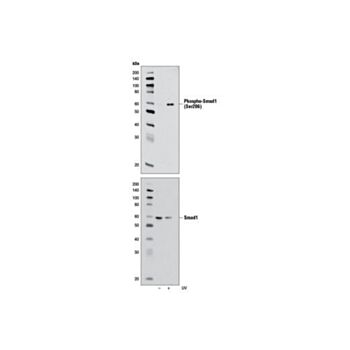
| Size | 20 µl |
| Reactivity | H |
| Sensitivity | Endogenous |
| Molecular Weight (kDa) | 60 |
| Source/Isotype | Rabbit IgG |
| Application/Dilution | {Western Blotting: 1:1000, Immunoprecipitation: 1:50} |
| Storage | Supplied in 10 mm sodium HEPES (pH 7.5), 150 mm NaCl, 100 µg/mL BSA, 50% glycerol and less than 0.02% sodium azide. Store at –20°C. Do not aliquot the antibody. |
| Specificity/Sensitivity | Phospho-SMAD1 (Ser206) (D40B7) Rabbit mAb recognizes endogenous levels of SMAD1 protein only when phosphorylated at Ser206. |
| Species Reactivity | Human |
| Source/Purification | Monoclonal antibody is produced by immunizing animals with a synthetic phosphopeptide corresponding to residues surrounding Ser206 of human SMAD1 protein. |
| Background | Bone morphogenetic proteins (BMPs) constitute a large family of signaling molecules that regulate a wide range of critical processes including morphogenesis, cell-fate determination, proliferation, differentiation, and apoptosis (1,2). BMP receptors are members of the TGF-β superfamily of Ser/Thr kinase receptors. Ligand binding induces multimerization, autophosphorylation, and activation of these receptors (3-5). They subsequently phosphorylate SMAD1 at Ser463 and Ser465 in the carboxy-terminal motif SSXS, as well as SMAD5 and SMAD9 (SMAD8) at their corresponding sites. These phosphorylated SMADs dimerize with the coactivating SMAD4 and translocate to the nucleus, where they regulate the transcription of target genes (5). MAP kinases and CDKs 8 and 9 are also reported to phosphorylate residues in the linker region of SMAD1, including Ser206. Phosphorylation of SMAD1 at Ser206 recruits Smurf1 to the linker region and leads to the degradation of SMAD1 (6). Phosphorylation at this site also promotes SMAD1 transcriptional activity by recruiting YAP to the linker region (7). |
| SKU | CSIG-5753T |
|---|---|
| Supplier Part Number | 5753T |
| UM | EA |
| UNSPSC | 12352203 |
| Manufacturer | Cell Signaling |
| MSDS URL | Click here |
| Temperature | -20C |
| CountryOfOrigin | United States |
| ProductLine | CSIG |
| Qty | 1 |
| MinOrderQty | 1 |
| Weight | 7.000000 |
| Lead Time | 5 |
| Hazardous | N |
| Energy Star | No |
| Green | No |
| Controlled | N |