We use cookies to make your experience better. To comply with the new e-Privacy directive, we need to ask for your consent to set the cookies. Learn about our cookie policy.

Cell Signaling Arginase-1 (D4e3m) Xp Rabbit mAb (Alexa Fluor 488 Conjugate)
List Price $469.65 Your Price $469.65
Cell Signaling Arginase-1 (D4e3m) Xp Rabbit mAb (Alexa Fluor 488 Conjugate) - CSIG (Additional S&H or Hazmat Fees May Apply)
NETA PART: CSIG-66297S
MFG.PART: 66297S
UNSPSC: 12352203
Manufacturer: Cell Signaling


| Size | 100 µl (50 tests) |
| Reactivity | H M R |
| Sensitivity | Endogenous |
| Source/Isotype | Rabbit IgG |
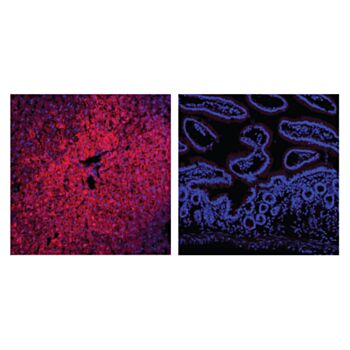
| Application/Dilution | {Immunofluorescence (Frozen): 1:100, Immunofluorescence (Immunocytochemistry): 1:100 - 1:200} |
| Storage | Supplied in PBS (pH 7.2), less than 0.1% sodium azide and 2 mg/mL BSA. Store at 4°C. Do not aliquot the antibody. Protect from light. Do not freeze. |
| Specificity/Sensitivity | Arginase-1 (D4E3M™) XP® Rabbit mAb (Alexa Fluor® 488 Conjugate) recognizes endogenous levels of total arginase-1 protein. This antibody does not cross-react with arginase-2. |
| Species Reactivity | Human, Mouse, Rat |
| Source/Purification | Monoclonal antibody is produced by immunizing animals with a synthetic peptide corresponding to residues surrounding Val47 of human arginase-1 protein. |
| Background | L-arginine plays a critical role in regulating the immune system (1-3). In inflammation, cancer, and certain other pathological conditions, myeloid cell differentiation is inhibited leading to a heterogeneous population of immature myeloid cells, known as myeloid-derived suppressor cells (MDSCs). MDSCs are recruited to sites of cancer-associated inflammation and express high levels of arginase-1 (4). Arginase-1 catalyzes the final step of the urea cycle converting L-arginine to L-ornithine and urea (5). Thus, MDSCs increase the catabolism of L-arginine resulting in L-arginine depletion in the inflammatory microenvironment of cancer (4,6). The reduced availability of L-arginine suppresses T cell proliferation and function and thus contributes to tumor progression (4,6). Arginase-1 is of great interest to researchers looking for a therapeutic target to inhibit the function of MDSCs in the context of cancer immunotherapy (7). In addition, research studies have demonstrated that arginase-1 distinguishes primary hepatocellular carcinoma (HCC) from metastatic tumors in the liver, indicating its value as a potential biomarker in the diagnosis of HCC (8,9). |
| SKU | CSIG-66297S |
|---|---|
| Supplier Part Number | 66297S |
| UM | EA |
| UNSPSC | 12352203 |
| Manufacturer | Cell Signaling |
| MSDS URL | Click here |
| Temperature | +4C |
| CountryOfOrigin | United States |
| ProductLine | CSIG |
| Qty | 1 |
| MinOrderQty | 1 |
| Weight | 7.000000 |
| Lead Time | 5 |
| Hazardous | N |
| Energy Star | No |
| Green | No |
| Controlled | N |