We use cookies to make your experience better. To comply with the new e-Privacy directive, we need to ask for your consent to set the cookies. Learn about our cookie policy.

Cell Signaling Trpc3 (D4p5s) Rabbit mAb
List Price $354.51 Your Price $354.51
Cell Signaling Trpc3 (D4p5s) Rabbit mAb - CSIG (Additional S&H or Hazmat Fees May Apply)
NETA PART: CSIG-77934S
MFG.PART: 77934S
UNSPSC: 12352203
Manufacturer: Cell Signaling


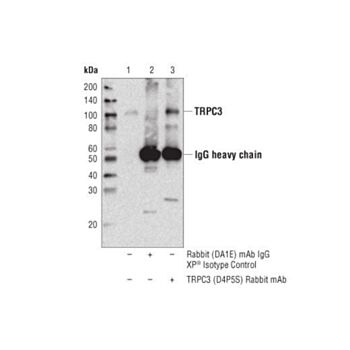
| Size | 100 µl |
| Reactivity | H M R |
| Sensitivity | Endogenous |
| Molecular Weight (kDa) | 105 |
| Source/Isotype | Rabbit IgG |
| Application/Dilution | {Western Blotting: 1:1000, Immunoprecipitation: 1:50} |
| Storage | Supplied in 10 mm sodium HEPES (pH 7.5), 150 mm NaCl, 100 µg/mL BSA, 50% glycerol and less than 0.02% sodium azide. Store at –20°C. Do not aliquot the antibody. |
| Specificity/Sensitivity | TRPC3 (D4P5S) Rabbit mAb recognizes endogeneous levels of total TRPC3 protein. This antibody does not cross-react with TRPC6 or TRPC7 proteins. |
| Species Reactivity | Human, Mouse, Rat |
| Source/Purification | Monoclonal antibody is produced by immunizing animals with a synthetic peptide corresponding to residues near the carboxy terminus of human TRPC3 protein. |
| Background | Transient Receptor Potential Canonical 3 (TRPC3) belongs to the superfamily of TRP cation channels. The TRPC subfamily (TRPC1-7) is a group of calcium-permeable cation channels that mediates the increase in intracellular [Ca2+] following activation by g-protein-coupled receptors or receptor tyrosine kinases (1). TRPC3 is mainly expressed in the brain and various other tissues, though at a much lower level (2). In the brain, TRPC3 is involved in BDNF-induced axonal growth cone plasticity, dendritic spine formation, and neuronal survival (3-6). It is also required for synaptic transmission and motor coordination (7). Outside of the central nervous system, TRPC3 also exerts other important biological functions such as regulating cardiac and vascular contractility, maintaining Ca2+ homeostasis in primary T cells and endothelial cells (8-10). TRPC3 is activated by diacylglycerol and Inositol 1,4,5-trisphosphate (11,12). It is also activated by internal calcium store depletion and regulates mitochondrial calcium uptake (13,14). |
| SKU | CSIG-77934S |
|---|---|
| Supplier Part Number | 77934S |
| UM | EA |
| UNSPSC | 12352203 |
| Manufacturer | Cell Signaling |
| MSDS URL | Click here |
| Temperature | -20C |
| CountryOfOrigin | United States |
| ProductLine | CSIG |
| Qty | 1 |
| MinOrderQty | 1 |
| Weight | 7.000000 |
| Lead Time | 5 |
| Hazardous | N |
| Energy Star | No |
| Green | No |
| Controlled | N |