We use cookies to make your experience better. To comply with the new e-Privacy directive, we need to ask for your consent to set the cookies. Learn about our cookie policy.

Cell Signaling Mff Antibody
List Price
$320.17
Your Price
$320.17
Cell Signaling Mff Antibody - CSIG (Additional S&H or Hazmat Fees May Apply)
NETA PART:
CSIG-86668S
MFG.PART:
86668S
UNSPSC:
12352203
Manufacturer:
Cell Signaling


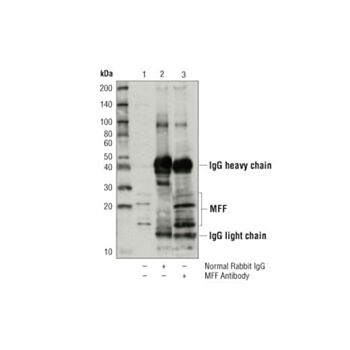
| Size | 100 µl |
| Reactivity | H M |
| Sensitivity | Endogenous |
| Molecular Weight (kDa) | 25, 27, 30, 35 |
| Source/Isotype | Rabbit |
| Application/Dilution | {Western Blotting: 1:1000, Immunoprecipitation: 1:200} |
| Storage | Supplied in 10 mm sodium HEPES (pH 7.5), 150 mm NaCl, 100 µg/mL BSA and 50% glycerol. Store at –20°C. Do not aliquot the antibody. |
| Specificity/Sensitivity | MFF Antibody recognizes endogenous levels of total MFF protein. Based upon sequence alignment, this antibody is predicted to react with isoforms 1-5 of human MFF protein. |
| Species Reactivity | Human, Mouse |
| Source/Purification | Polyclonal antibodies are produced by immunizing animals with a synthetic peptide corresponding to residues surrounding Lys52 of human MFF protein, isoform 1. Antibodies are purified by protein A and peptide affinity chromatography. |
| Background | Mitochondrial fission factor (MFF) is a tail-anchored protein that resides within the outer mitochondrial membrane and is part of the mitochondrial fission complex. MFF participates in mitochondrial fission by serving as one of multiple receptors for the GTPase dynamin-related protein 1 (Drp1) (1-4). Research studies have also shown that MFF is a peroxisomal membrane protein and participates in peroxisome fission by serving as a receptor for another GTPase, dynamin-like protein 1 (5,6).Research studies have demonstrated that the ability of MFF to drive acute mitochondrial fission in response to mitochondrial stress is controlled by AMPK-dependent phosphorylation. AMPK directly phosphorylates MFF at two sites to allow for enhanced recruitment of Drp1 to the mitochondra (7). Multiple isoforms of MFF are expressed as a result of alternative splicing (8). One of the major phosphoacceptor sites of MFF (Ser172 of human isoform 1/Ser146 of human isoforms 2-5) lies within an AMPK phsophorylation motif that spans the boundary of differentially spliced exons of MFF isoforms, suggesting that MFF splice isoforms are phosphorylated by AMPK to varying degrees. |
| SKU | CSIG-86668S |
|---|---|
| Supplier Part Number | 86668S |
| UM | EA |
| UNSPSC | 12352203 |
| Manufacturer | Cell Signaling |
| MSDS URL | Click here |
| Temperature | -20C |
| CountryOfOrigin | United States |
| ProductLine | CSIG |
| Qty | 1 |
| MinOrderQty | 1 |
| Weight | 7.000000 |
| Lead Time | 5 |
| Hazardous | N |
| Energy Star | No |
| Green | No |
| Controlled | N |