We use cookies to make your experience better. To comply with the new e-Privacy directive, we need to ask for your consent to set the cookies. Learn about our cookie policy.

Cell Signaling Phospho-Epha3 (Tyr779) (D10h1) Rabbit mAb
List Price $419.15 Your Price $419.15
Cell Signaling Phospho-Epha3 (Tyr779) (D10h1) Rabbit mAb - CSIG (Additional S&H or Hazmat Fees May Apply)
NETA PART: CSIG-8862S
MFG.PART: 8862S
UNSPSC: 12352203
Manufacturer: Cell Signaling


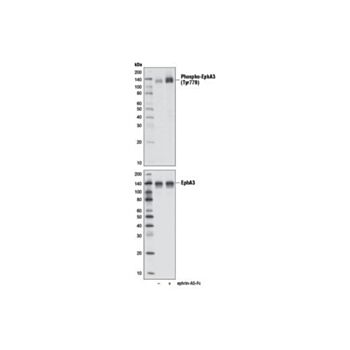
| Size | 100 µl |
| Reactivity | H |
| Sensitivity | Endogenous |
| Molecular Weight (kDa) | 135 |
| Source/Isotype | Rabbit |
| Application/Dilution | {Western Blotting: 1:1000, Immunoprecipitation: 1:100} |
| Storage | Supplied in 10 mm sodium HEPES (pH 7.5), 150 mm NaCl, 100 µg/mL BSA, 50% glycerol and less than 0.02% sodium azide. Store at –20°C. Do not aliquot the antibody. |
| Specificity/Sensitivity | Phospho-EphA3 (Tyr779) (D10H1) Rabbit mAb recognizes endogenous levels of EphA3 protein only when phosphorylated at Tyr779. This antibody cross-reacts with EphA2, EphA4, and EphA5 at the corresponding phosphosites. |
| Species Reactivity | Human |
| Source/Purification | Monoclonal antibody is produced by immunizing animals with a synthetic phosphopeptide corresponding to residues surrounding Tyr779 of human EphA3 protein. |
| Background | The Eph receptors are the largest known family of receptor tyrosine kinases (RTKs). They can be divided into two groups based on sequence similarity and on their preference for a subset of ligands. While EphA receptors bind to a glycosylphosphatidylinositol-anchored ephrin A ligand, EphB receptors bind to ephrin B proteins that have a transmembrane and cytoplasmic domain (1,2). Research studies have shown that Eph receptors and ligands may be involved in many diseases including cancer (3). Both ephrin A and B ligands have dual functions. As RTK ligands, ephrins stimulate the kinase activity of Eph receptors and activate signaling pathways in receptor-expressing cells. The ephrin extracellular domain is sufficient for this function as long as it is clustered (4). The second function of ephrins has been described as "reverse signaling", whereby the cytoplasmic domain becomes tyrosine phosphorylated, allowing interactions with other proteins that may activate signaling pathways in the ligand-expressing cells (5).The EphA3 receptor preferentially binds ephrin-A5. This ligand-receptor interaction stimulates EphA3 signaling, regulates cell adhesion and migration, and induces cellular morphologic responses (6-8). EphA3 plays a critical role in callosal axon guidance (9), retinotectal mapping of neurons (10), as well as cardiac cell migration and differentiation (11). Investigators have shown that somatic mutations in functional domains of EphA3 are linked to lung cancer progression (12). In addition, EphA3 expression levels have been correlated with tumor angiogenesis and progression in gastric and colorectal carcinoma (13,14).Both Tyr602 and Tyr779 phosphorylation are involved in ephrin-A5 induced EphA3 receptor activation (15). Phosphorylated Tyr779 of the EphA3 receptor is the binding site for the SH2-domain-containing Crk adaptor, which in turn activates the small GTPase RhoA (16). |
| SKU | CSIG-8862S |
|---|---|
| Supplier Part Number | 8862S |
| UM | EA |
| UNSPSC | 12352203 |
| Manufacturer | Cell Signaling |
| MSDS URL | Click here |
| Temperature | -20C |
| CountryOfOrigin | United States |
| ProductLine | CSIG |
| Qty | 1 |
| MinOrderQty | 1 |
| Weight | 7.000000 |
| Lead Time | 5 |
| Hazardous | N |
| Energy Star | No |
| Green | No |
| Controlled | N |