We use cookies to make your experience better. To comply with the new e-Privacy directive, we need to ask for your consent to set the cookies. Learn about our cookie policy.

Cell Signaling Phospho-Brca1 (Ser1524) Antibody
List Price $151.50 Your Price $151.50
Cell Signaling Phospho-Brca1 (Ser1524) Antibody - CSIG (Additional S&H or Hazmat Fees May Apply)
NETA PART: CSIG-9009T
MFG.PART: 9009T
UNSPSC: 12352203
Manufacturer: Cell Signaling


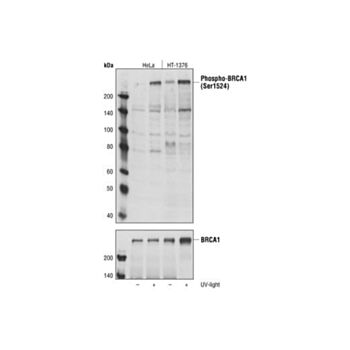
| Size | 20 µl |
| Reactivity | H |
| Sensitivity | Endogenous |
| Molecular Weight (kDa) | 220 |
| Source/Isotype | Rabbit |
| Application/Dilution | {Western Blotting: 1:1000} |
| Storage | Supplied in 10 mm sodium HEPES (pH 7.5), 150 mm NaCl, 100 µg/mL BSA and 50% glycerol. Store at –20°C. Do not aliquot the antibody. |
| Specificity/Sensitivity | Phospho-BRCA1 (Ser1524) Antibody detects endogenous levels of BRCA1 only when phosphorylated at Ser1524. |
| Species Reactivity | Human |
| Source/Purification | Polyclonal antibodies are produced by immunizing animals with a synthetic phosphopeptide corresponding to residues surrounding Ser1524 of human BRCA1. Antibodies are purified by protein A and peptide affinity chromatography. |
| Background | The breast cancer susceptibility proteins BRCA1 and BRCA2 are frequently mutated in cases of hereditary breast and ovarian cancers and have roles in multiple processes related to DNA damage, repair, cell cycle progression, transcription, ubiquitination, and apoptosis (1-4). BRCA2 has been shown to be required for localization of Rad51 to sites of double stranded breaks (DSBs) in DNA, and cells lacking BRCA1 and BRCA2 cannot repair DSBs through the Rad51-dependent process of homologous recombination (HR) (5). Numerous DNA damage-induced phosphorylation sites on BRCA1 have been identified, including Ser988, 1189, 1387, 1423, 1457, 1524, and 1542, and kinases activated in a cell cycle-dependent manner, including Aurora A and CDK2, can also phosphorylate BRCA1 at Ser308 and Ser1497, respectively (6-10). Cell cycle-dependent phosphorylation of BRCA2 at Ser3291 by CDKs has been proposed as a mechanism to switch off HR as cells progress beyond S-phase by blocking the carboxy terminal Rad51 binding site (11).In Xenopus, in response to DNA damage, ATR-dependent and Claspin-mediated recruitment of BRCA1 leads to phosphorylation at Ser1524 (12). |
| SKU | CSIG-9009T |
|---|---|
| Supplier Part Number | 9009T |
| UM | EA |
| UNSPSC | 12352203 |
| Manufacturer | Cell Signaling |
| MSDS URL | Click here |
| Temperature | -20C |
| CountryOfOrigin | United States |
| ProductLine | CSIG |
| Qty | 1 |
| MinOrderQty | 1 |
| Weight | 7.000000 |
| Lead Time | 5 |
| Hazardous | N |
| Energy Star | No |
| Green | No |
| Controlled | N |