We use cookies to make your experience better. To comply with the new e-Privacy directive, we need to ask for your consent to set the cookies. Learn about our cookie policy.

Cell Signaling Trap1/Hsp75 (D3d7n) Rabbit mAb
List Price
$354.51
Your Price
$354.51
Cell Signaling Trap1/Hsp75 (D3d7n) Rabbit mAb - CSIG (Additional S&H or Hazmat Fees May Apply)
NETA PART:
CSIG-92345S
MFG.PART:
92345S
UNSPSC:
12352203
Manufacturer:
Cell Signaling


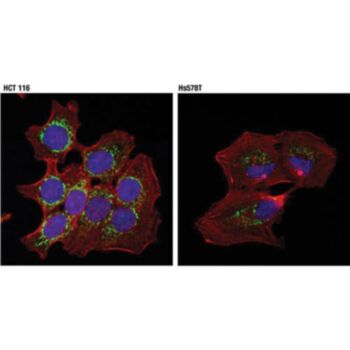
| Size | 100 µl |
| Reactivity | H |
| Sensitivity | Endogenous |
| Molecular Weight (kDa) | 75 |
| Source/Isotype | Rabbit IgG |
| Application/Dilution | {Western Blotting: 1:1000, Immunoprecipitation: 1:50, Immunofluorescence (Immunocytochemistry): 1:100} |
| Storage | Supplied in 10 mm sodium HEPES (pH 7.5), 150 mm NaCl, 100 µg/mL BSA, 50% glycerol and less than 0.02% sodium azide. Store at –20°C. Do not aliquot the antibody. |
| Specificity/Sensitivity | TRAP1/HSP75 (D3D7N) Rabbit mAb recognizes endogenous levels of total TRAP1/HSP75 protein. |
| Species Reactivity | Human |
| Source/Purification | Monoclonal antibody is produced by immunizing animals with a synthetic peptide corresponding to residues surrounding Pro70 of human TRAP1/HSP75 protein. |
| Background | TNF receptor-associated protein 1 (TRAP1), also known as HSP75, is a mitochondrial chaperone and ATPase that was originally identified as a protein that interacts with the TNF receptor. Although a member of the HSP90 family, TRAP1 is not heat-inducible but is upregulated by glucose deprivation, oxidative injury, and UV irradiation. An amino-terminal mitochondrial localization sequence results in localization of TRAP1 within mitochondria (1). Overexpression of TRAP1 decreases oxidative stress, suggesting a protective role in ischemia injury (2). Research studies demonstrate that silencing of TRAP1 enhances cytochrome C release and apoptosis, with additional evidence indicating that TRAP1 can protect cells from cell death by inhibiting the generation of reactive oxygen species (3). TRAP1 is a substrate of the mitochondrial serine/threonine kinase PINK1, whose corresponding gene is mutated in some forms of early-onset Parkinsons disease (PD). PINK1 protects cells from oxidative stress-induced cell death by suppressing release of cytochrome C from mitochondria. PD-linked PINK1 mutations impair the ability of PINK1 to phosphorylate TRAP1 and leads to impaired cell survival (4). Finally, TRAP1 alleviates α-synuclein induced toxicity and rescues the PINK1 loss-of-function phenotype (5). |
| SKU | CSIG-92345S |
|---|---|
| Supplier Part Number | 92345S |
| UM | EA |
| UNSPSC | 12352203 |
| Manufacturer | Cell Signaling |
| MSDS URL | Click here |
| Temperature | -20C |
| CountryOfOrigin | United States |
| ProductLine | CSIG |
| Qty | 1 |
| MinOrderQty | 1 |
| Weight | 7.000000 |
| Lead Time | 5 |
| Hazardous | N |
| Energy Star | No |
| Green | No |
| Controlled | N |