We use cookies to make your experience better. To comply with the new e-Privacy directive, we need to ask for your consent to set the cookies. Learn about our cookie policy.

Cell Signaling Tet2 (D9k3e) Rabbit mAb (Mouse Specific)
List Price $354.51 Your Price $354.51
Cell Signaling Tet2 (D9k3e) Rabbit mAb (Mouse Specific) - CSIG (Additional S&H or Hazmat Fees May Apply)
NETA PART: CSIG-92529S
MFG.PART: 92529S
UNSPSC: 12352203
Manufacturer: Cell Signaling


| Size | 100 µl |
| Reactivity | M |
| Sensitivity | Endogenous |
| Molecular Weight (kDa) | 280 |
| Source/Isotype | Rabbit IgG |
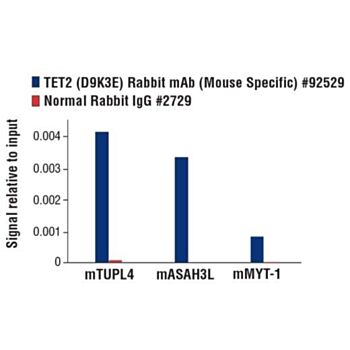
| Application/Dilution | {Western Blotting: 1:1000, Chromatin IP: 1:50, Chromatin IP-seq: 1:50} |
| Storage | Supplied in 10 mm sodium HEPES (pH 7.5), 150 mm NaCl, 100 µg/mL BSA, 50% glycerol and less than 0.02% sodium azide. Store at –20°C. Do not aliquot the antibody. |
| Specificity/Sensitivity | TET2 (D9K3E) Rabbit mAb recognizes endogenous levels of total mouse TET2 protein. |
| Species Reactivity | Mouse |
| Source/Purification | Monoclonal antibody is produced by immunizing animals with recombinant protein surrounding Ala1580 of mouse TET2 protein. |
| Background | Methylation of DNA at cytosine residues is a heritable, epigenetic modification that is critical for proper regulation of gene expression, genomic imprinting, and mammalian development (1,2). 5-methylcytosine is a repressive epigenetic mark established de novo by two enzymes, DNMT3a and DNMT3b, and is maintained by DNMT1 (3, 4). 5-methylcytosine was originally thought to be passively depleted during DNA replication. However, subsequent studies have shown that Ten-Eleven Translocation (TET) proteins TET1, TET2, and TET3 can catalyze the oxidation of methylated cytosine to 5-hydroxymethylcytosine (5-hmC) (5). Additionally, TET proteins can further oxidize 5-hmC to form 5-formylcytosine (5-fC) and 5-carboxylcytosine (5-caC), both of which are excised by thymine-DNA glycosylase (TDG), effectively linking cytosine oxidation to the base excision repair pathway and supporting active cytosine demethylation (6,7). TET2 is the most frequently mutated gene in myeloid dysplastic syndrome (MDS), a dysplasia of myeloid, megakaryocytic, and/or erythroid cell lineages, of which 30% progress to acute myeloid leukemia (AML) (8, 9). It is also mutated in diffuse large B-cell lymphoma (10). TET2 protein expression is often reduced in solid tumors such as prostate cancer, melanoma, and oral squamous cell carcinoma (11-13). |
| SKU | CSIG-92529S |
|---|---|
| Supplier Part Number | 92529S |
| UM | EA |
| UNSPSC | 12352203 |
| Manufacturer | Cell Signaling |
| MSDS URL | Click here |
| Temperature | -20C |
| CountryOfOrigin | United States |
| ProductLine | CSIG |
| Qty | 1 |
| MinOrderQty | 1 |
| Weight | 7.000000 |
| Lead Time | 5 |
| Hazardous | N |
| Energy Star | No |
| Green | No |
| Controlled | N |