We use cookies to make your experience better. To comply with the new e-Privacy directive, we need to ask for your consent to set the cookies. Learn about our cookie policy.

Cell Signaling Cops5 (D15g6) Rabbit mAb
List Price $354.51 Your Price $354.51
Cell Signaling Cops5 (D15g6) Rabbit mAb - CSIG (Additional S&H or Hazmat Fees May Apply)
NETA PART: CSIG-9444S
MFG.PART: 9444S
UNSPSC: 12352203
Manufacturer: Cell Signaling


| Size | 100 µl |
| Reactivity | H M R Mk |
| Sensitivity | Endogenous |
| Molecular Weight (kDa) | 37 |
| Source/Isotype | Rabbit IgG |
| Application/Dilution | {Western Blotting: 1:1000, Immunoprecipitation: 1:100} |
| Storage | Supplied in 10 mm sodium HEPES (pH 7.5), 150 mm NaCl, 100 µg/mL BSA, 50% glycerol and less than 0.02% sodium azide. Store at –20°C. Do not aliquot the antibody. |
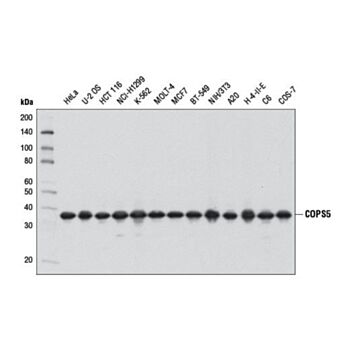
| Specificity/Sensitivity | COPS5 (D15G6) Rabbit mAb recognizes endogenous levels of total COPS5 protein. This antibody does not cross-react with PSMD14/POH1. |
| Species Reactivity | Human, Mouse, Rat, Monkey |
| Source/Purification | Monoclonal antibody is produced by immunizing animals with a synthetic peptide corresponding to residues near the amino terminus of human COPS5 protein. |
| Background | The COP9 Signalosome (CSN) is a ubiquitously expressed multiprotein complex that is involved in a vast array of cellular and developmental processes, which is thought to be attributed to its control over the ubiquitin-proteasome pathway. Typically, the CSN is composed of eight highly conserved subunits (CSN1-CSN8), each of which is homologous to one of the eight subunits that form the lid of the 26S proteasome particle, suggesting that these complexes have a common evolutionary ancestor (1). CSN was first identified in Arabidopsis thaliana mutants with a light-grown seedling phenotype when grown in the dark (2-4). The subsequent cloning of the constitutive morphogenesis 9 (cop9) mutant from Arabidopsis thaliana was soon followed by the biochemical purification of the COP9-containing multiprotein complex (4). It is now widely accepted that the CSN directly interacts with cullin-RING ligase (CRL) families of ubiquitin E3 complexes, and that CSN is required for their proper function (5). In addition, CSN may also regulate protein homeostasis through its association with protein kinases and deubiquitinating enzymes. Collectively, these activities position the CSN as a pivotal regulator of the DNA-damage response, cell-cycle control, and gene expression (1).COPS5/CSN5/Jab1 (c-Jun activation domain-binding protein-1) was originally identified as a transcriptional coactivator of c-Jun and subsequently discovered to be a fifth component and integral part of the CSN (6). As the catalytic center of the CSN, COPS5 is able to integrate multiple functions of the CSN complex such as cell-cycle control, transcription, and DNA-damage response by regulating the activity of CRLs through deneddylation of cullins (7). Indeed, COPS5 harbors an Mpr1-Pad1-N-terminal (MPN) domain with an embedded Jab1/CSN5 MPN domain metalloenzyme (JAMM) motif that is essential for the CSN isopeptidase activity responsible for deneddylation of CRLs. COPS5 is an evolutionarily conserved 38 kDa protein in humans, mice, fission yeast, and plants, which suggests that it is critical to cell survival and proliferation. A role for COPS5 as a positive regulator of cellular proliferation is supported by evidence that it functionally inactivates several key tumor suppressors, such as p53, RUNX3, Smad4, and p27 Kip1 through altered subcellular localization, degradation, and deneddylation (8-12). These findings are underscored by the observation that COPS5 overexpression has been identified in a number of different tumor types and has been implicated in the initiation and progression of several types of cancer (13). Moreover, COPS5-deficient mice display an embryonically lethal phenotype highlighted by elevated expression of COPS5 targets, such as p53 and p27 (14,15). |
| SKU | CSIG-9444S |
|---|---|
| Supplier Part Number | 9444S |
| UM | EA |
| UNSPSC | 12352203 |
| Manufacturer | Cell Signaling |
| MSDS URL | Click here |
| Temperature | -20C |
| CountryOfOrigin | United States |
| ProductLine | CSIG |
| Qty | 1 |
| MinOrderQty | 1 |
| Weight | 7.000000 |
| Lead Time | 5 |
| Hazardous | N |
| Energy Star | No |
| Green | No |
| Controlled | N |