We use cookies to make your experience better. To comply with the new e-Privacy directive, we need to ask for your consent to set the cookies. Learn more.
Cell Signaling C-Fos (9f6) Rabbit mAb (Pe Conjugate)
List Price
$454.50
Your Price
$454.50
Cell Signaling C-Fos (9f6) Rabbit mAb (Pe Conjugate) - CSIG (Additional S&H or Hazmat Fees May Apply)
NETA PART:
CSIG-14609S
MFG.PART:
14609S
UNSPSC:
41116133
Manufacturer:
Cell Signaling
| Size | 100 µl (50 tests) |
| Reactivity | H M R |
| Sensitivity | Endogenous |
| Source/Isotype | Rabbit IgG |
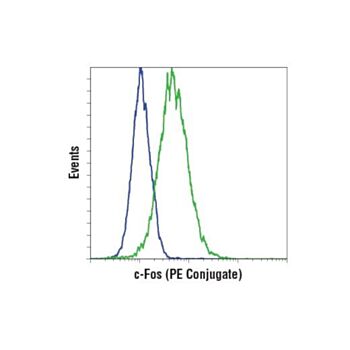
| Application/Dilution | {Flow Cytometry (Fixed/Permeabilized): 1:50} |
| Storage | Supplied in PBS (pH 7.2), less than 0.1% sodium azide and 2 mg/ml BSA. Store at 4°C. Do not aliquot the antibodies. Protect from light. Do not freeze. |
| Specificity/Sensitivity | c-Fos (9F6) Rabbit mAb (PE Conjugate) recognizes endogenous levels of total c-Fos protein. The antibody does not cross-react with other Fos proteins, including FosB, FRA1, or FRA2. |
| Species Reactivity | Human, Mouse, Rat |
| Source/Purification | Monoclonal antibody is produced by immunizing animals with a synthetic peptide corresponding to residues near the amino terminus of human c-Fos protein. |
| Background | The Fos family of nuclear oncogenes includes c-Fos, FosB, Fos-related antigen 1 (FRA1), and Fos-related antigen 2 (FRA2) (1). While most Fos proteins exist as a single isoform, the FosB protein exists as two isoforms: full-length FosB and a shorter form, FosB2 (Delta FosB), which lacks the carboxy-terminal 101 amino acids (1-3). The expression of Fos proteins is rapidly and transiently induced by a variety of extracellular stimuli, including growth factors, cytokines, neurotransmitters, polypeptide hormones, and stress. Fos proteins dimerize with Jun proteins (c-Jun, JunB, and JunD) to form Activator Protein-1 (AP-1), a transcription factor that binds to TRE/AP-1 elements and activates transcription. Fos and Jun proteins contain the leucine-zipper motif that mediates dimerization and an adjacent basic domain that binds to DNA. The various Fos/Jun heterodimers differ in their ability to transactivate AP-1 dependent genes. In addition to increased expression, phosphorylation of Fos proteins by Erk kinases in response to extracellular stimuli may further increase transcriptional activity (4-6). Phosphorylation of c-Fos at Ser32 and Thr232 by Erk5 increases protein stability and nuclear localization (5). Phosphorylation of FRA1 at Ser252 and Ser265 by Erk1/2 increases protein stability and leads to overexpression of FRA1 in cancer cells (6). Following growth factor stimulation, expression of FosB and c-Fos in quiescent fibroblasts is immediate, but very short-lived, with protein levels dissipating after several hours (7). FRA1 and FRA2 expression persists longer, and appreciable levels can be detected in asynchronously growing cells (8). Deregulated expression of c-Fos, FosB, or FRA2 can result in neoplastic cellular transformation; however, Delta FosB lacks the ability to transform cells (2,3). |
| SKU | CSIG-14609S |
|---|---|
| Featured | No |
| Supplier Part Number | 14609S |
| UM | EA |
| UNSPSC | 41116133 |
| Manufacturer | Cell Signaling |
| MSDS URL | Click here |
| Temperature | +4C |
| CountryOfOrigin | United States |
| ProductLine | CSIG |
| Qty | 1 |
| MinOrderQty | 1 |
| Weight | 7.000000 |
| Lead Time | 5 |
| Hazardous | N |
| ACT Ecolabel | No |