We use cookies to make your experience better. To comply with the new e-Privacy directive, we need to ask for your consent to set the cookies. Learn about our cookie policy.

Cell Signaling Pd-L1 (Extrcellulr Domin Specific) (D8t4x) Rbbit mAb (Alex Fluor(R) 488 Conjugte) 100 Ul Apply) (Additional
List Price
$469.65
Your Price
$469.65
Cell Signaling Pd-L1 (Extrcellulr Domin Specific) (D8t4x) Rbbit mAb (Alex Fluor(R) 488 Conjugte) 100 Ul Apply) (Additional - CSIG (Additional S&H or Hazmat Fees May Apply)
NETA PART:
CSIG-25048S
MFG.PART:
25048S
UNSPSC:
12352203
Manufacturer:
Cell Signaling


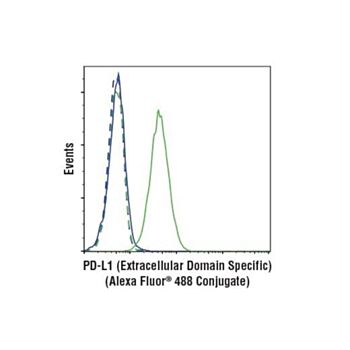
| Size | 100 µl (50 tests) |
| Reactivity | H |
| Sensitivity | Endogenous |
| Source/Isotype | Rabbit IgG |
| Application/Dilution | {Immunofluorescence (Immunocytochemistry): 1:200 - 1:800, Flow Cytometry (Fixed/Permeabilized): 1:50, Flow Cytometry (Live): 1:50} |
| Storage | Supplied in PBS (pH 7.2), less than 0.1% sodium azide and 2 mg/mL BSA. Store at 4°C. Do not aliquot the antibody. Protect from light. Do not freeze. |
| Specificity/Sensitivity | PD-L1 (Extracellular Domain Specific) (D8T4X) Rabbit mAb (Alexa Fluor® 488 Conjugate) recognizes endogenous levels of total PD-L1 protein. |
| Species Reactivity | Human |
| Source/Purification | Monoclonal antibody is produced by immunizing animals with mammalian cells expressing full length PD-L1 protein. |
| Background | Programmed cell death 1 ligand 1 (PD-L1, B7-H1, CD274) is a member of the B7 family of cell surface ligands that regulate T cell activation and immune responses. The PD-L1 ligand binds the PD-1 transmembrane receptor and inhibits T cell activation. PD-L1 was discovered following a search for novel B7 protein homologs and was later shown to be expressed by antigen presenting cells, activated T cells, and tissues including placenta, heart, and lung (1-3). Similar in structure to related B7 family members, PD-L1 protein contains extracellular IgV and IgC domains and a short, cytoplasmic region. Research studies demonstrate that PD-L1 is expressed in several tumor types, including melanoma, ovary, colon, lung, breast, and renal cell carcinomas (4-6). Expression of PD-L1 in cancer is associated with tumor-infiltrating lymphocytes, which mediate PD-L1 expression through the release of interferon gamma (7). Additional research links PD-L1 expression to cancers associated with viral infections (8,9). |
| SKU | CSIG-25048S |
|---|---|
| Supplier Part Number | 25048S |
| UM | EA |
| UNSPSC | 12352203 |
| Manufacturer | Cell Signaling |
| MSDS URL | Click here |
| Temperature | +4C |
| CountryOfOrigin | United States |
| ProductLine | CSIG |
| Qty | 1 |
| MinOrderQty | 1 |
| Weight | 7.000000 |
| Lead Time | 5 |
| Hazardous | N |
| Energy Star | No |
| Green | No |
| Controlled | N |