We use cookies to make your experience better. To comply with the new e-Privacy directive, we need to ask for your consent to set the cookies. Learn about our cookie policy.

Cell Signaling Di-Methyl-Histone H3 (Lys9) (D85b4) Xp Rabbit mAb (Alexa Fluor 647 Conjugate)
List Price
$505.00
Your Price
$505.00
Cell Signaling Di-Methyl-Histone H3 (Lys9) (D85b4) Xp Rabbit mAb (Alexa Fluor 647 Conjugate) - CSIG (Additional S&H or Hazmat Fees May Apply)
NETA PART:
CSIG-66070S
MFG.PART:
66070S
UNSPSC:
12352203
Manufacturer:
Cell Signaling


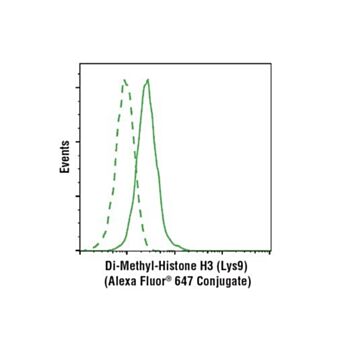
| Size | 100 µl (10 western blots) |
| Reactivity | H M R Mk |
| Sensitivity | Endogenous |
| Source/Isotype | Rabbit IgG |
| Application/Dilution | {Flow Cytometry (Fixed/Permeabilized): 1:50} |
| Storage | Supplied in PBS (pH 7.2), less than 0.1% sodium azide and 2 mg/mL BSA. Store at 4°C. Do not aliquot the antibody. Protect from light. Do not freeze. |
| Specificity/Sensitivity | Di-Methyl-Histone H3 (Lys9) (D85B4) XP® Rabbit mAb (Alexa Fluor® 647 Conjugate) detects endogenous levels of histone H3 only when di-methylated on Lys9. The antibody does not cross-react with non-methylated, mono-methylated or tri-methylated Histone H3 Lys9. In addition, the antibody does not cross-react with histone H3 di-methylated on Lys4, Lys27, or Lys36 and histone H4 di-methylated on Lys20. |
| Species Reactivity | Human, Mouse, Rat, Monkey |
| Source/Purification | Monoclonal antibody is produced by immunizing animals with a synthetic peptide corresponding to the amino terminus of histone H3 in which Lys9 is di-methylated. |
| Background | The nucleosome, made up of four core histone proteins (H2A, H2B, H3, and H4), is the primary building block of chromatin. Originally thought to function as a static scaffold for DNA packaging, histones have now been shown to be dynamic proteins, undergoing multiple types of post-translational modifications, including acetylation, phosphorylation, methylation, and ubiquitination (1). Histone methylation is a major determinant for the formation of active and inactive regions of the genome and is crucial for the proper programming of the genome during development (2,3). Arginine methylation of histones H3 (Arg2, 17, 26) and H4 (Arg3) promotes transcriptional activation and is mediated by a family of protein arginine methyltransferases (PRMTs), including the co-activators PRMT1 and CARM1 (PRMT4) (4). In contrast, a more diverse set of histone lysine methyltransferases has been identified, all but one of which contain a conserved catalytic SET domain originally identified in the Drosophila Su(var)3-9, Enhancer of zeste, and Trithorax proteins. Lysine methylation occurs primarily on histones H3 (Lys4, 9, 27, 36, 79) and H4 (Lys20) and has been implicated in both transcriptional activation and silencing (4). Methylation of these lysine residues coordinates the recruitment of chromatin modifying enzymes containing methyl-lysine binding modules such as chromodomains (HP1, PRC1), PHD fingers (BPTF, ING2), tudor domains (53BP1), and WD-40 domains (WDR5) (5-8). The discovery of histone demethylases, such as PADI4, LSD1, JMJD1, JMJD2, and JHDM1, has shown that methylation is a reversible epigenetic marker (9). |
| SKU | CSIG-66070S |
|---|---|
| Supplier Part Number | 66070S |
| UM | EA |
| UNSPSC | 12352203 |
| Manufacturer | Cell Signaling |
| MSDS URL | Click here |
| Temperature | +4C |
| CountryOfOrigin | United States |
| ProductLine | CSIG |
| Qty | 1 |
| MinOrderQty | 1 |
| Weight | 7.000000 |
| Lead Time | 5 |
| Hazardous | N |
| Energy Star | No |
| Green | No |
| Controlled | N |