We use cookies to make your experience better. To comply with the new e-Privacy directive, we need to ask for your consent to set the cookies. Learn about our cookie policy.

Cell Signaling Acetyl-Histone H2az (Lys4/Lys7) (D3v1i) Rabbit mAb (Alexa Fluor 488 Conjugate)
List Price
$497.93
Your Price
$497.93
Cell Signaling Acetyl-Histone H2az (Lys4/Lys7) (D3v1i) Rabbit mAb (Alexa Fluor 488 Conjugate) - CSIG (Additional S&H or Hazmat Fees May Apply)
NETA PART:
CSIG-96139S
MFG.PART:
96139S
UNSPSC:
12352203
Manufacturer:
Cell Signaling


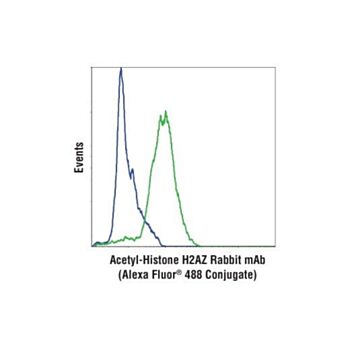
| Size | 100 µl (50 tests) |
| Reactivity | H M R |
| Sensitivity | Endogenous |
| Source/Isotype | Rabbit IgG |
| Application/Dilution | {Flow Cytometry (Fixed/Permeabilized): 1:50} |
| Storage | Supplied in PBS (pH 7.2), less than 0.1% sodium azide and 2 mg/mL BSA. Store at 4°C. Do not aliquot the antibody. Protect from light. Do not freeze. |
| Specificity/Sensitivity | Acetyl-Histone H2AZ (Lys4/Lys7) Rabbit mAb (Alexa Fluor® 488 Conjugate) recognizes endogenous levels of histone H2AZ protein only when acetylated at Lys4 and/or Lys7. This antibody does not cross-react with other acetylated histones, including histone H2A acetylated at Lys5. This antibody also detects a band around 22 kDa, which is most likely monoubiquitylated histone H2AZ that is acetylated on Lys4 and Lys7. |
| Species Reactivity | Human, Mouse, Rat |
| Source/Purification | Monoclonal antibody is produced by immunizing animals with a synthetic peptide corresponding to residues surrounding acetylated Lys4 and Lys7 of human H2AZ protein. |
| Background | Modulation of chromatin structure plays a critical role in the regulation of transcription in eukaryotes. The nucleosome, made up of four core histone proteins (H2A, H2B, H3 and H4), is the primary building block of chromatin. In addition to the growing number of post-translational histone modifications regulating chromatin structure, cells can also exchange canonical histones with variant histones that can directly or indirectly modulate chromatin structure (1). There are five major variants of histone H2A: canonical H2A (most abundant), H2A.X, MacroH2A, H2ABbd and H2A.Z (2). Histone H2A.Z, the most conserved variant across species, functions as both a positive and negative regulator of transcription and is important for chromosome stability (2). Several homologous protein complexes, such as SWR-C (S. cerevisiae), TIP60 (D. melanogaster) and SRCAP (mammals), have been shown to catalyze the ATP-dependent exchange of H2A.Z for H2A in the nucleosome (3,4,5). This exchange of histone H2A variants changes histone-histone interactions in the nucleosome core and alters an acidic patch on the surface of the nucleosome, resulting in changes in nucleosome stability and binding of non-histone proteins such as HP1α (6,7). |
| SKU | CSIG-96139S |
|---|---|
| Supplier Part Number | 96139S |
| UM | EA |
| UNSPSC | 12352203 |
| Manufacturer | Cell Signaling |
| MSDS URL | Click here |
| Temperature | +4C |
| CountryOfOrigin | United States |
| ProductLine | CSIG |
| Qty | 1 |
| MinOrderQty | 1 |
| Weight | 7.000000 |
| Lead Time | 5 |
| Hazardous | N |
| Energy Star | No |
| Green | No |
| Controlled | N |